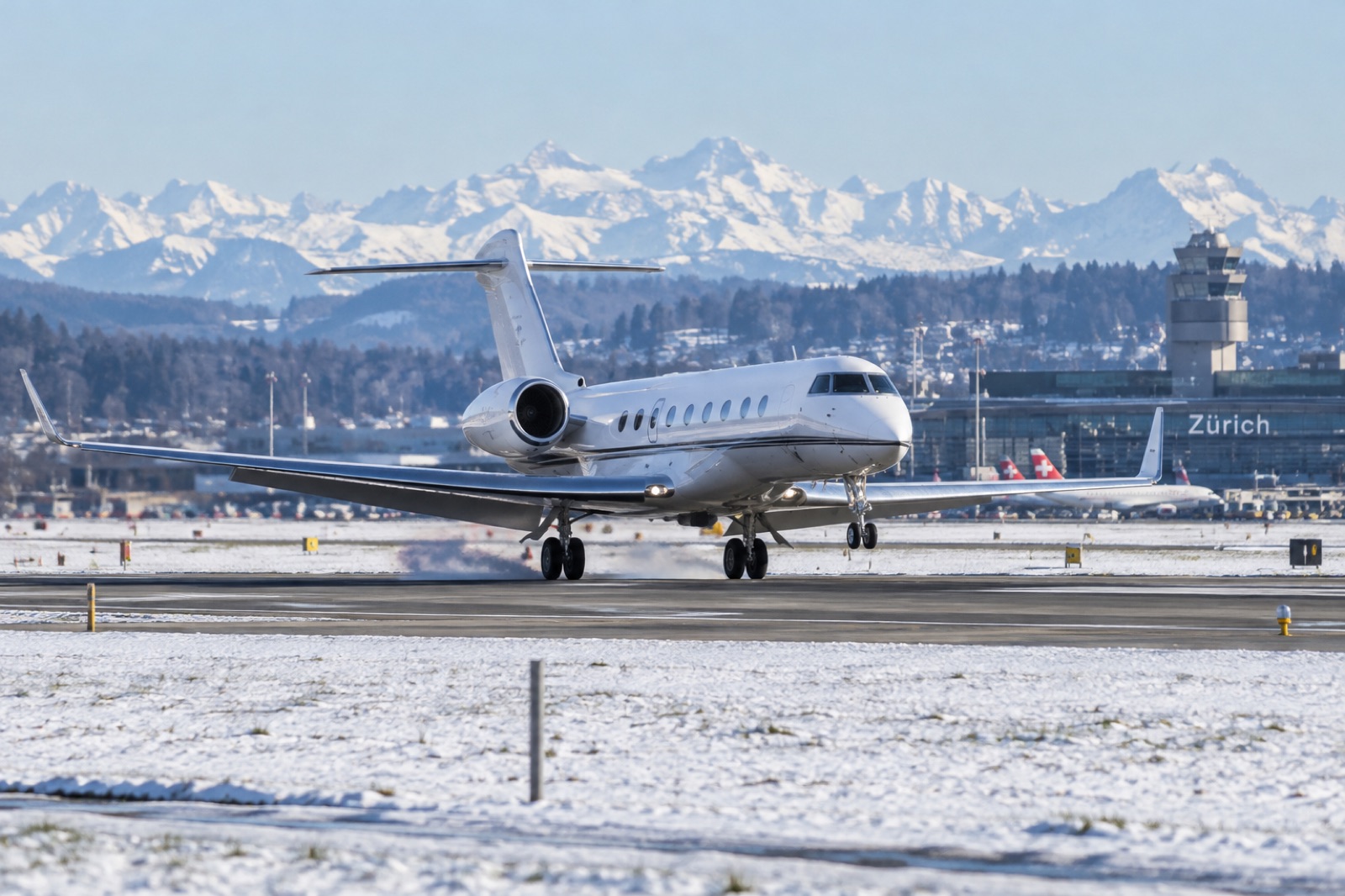
For one week in January, Zurich becomes a drop-off point with a two-hour clock. A broker's guide to WEF 2027: when the rules are published, why the large-cabin jet rarely spends the week where it lands, the restricted airspace over Davos, the single helicopter landing site, Samedan and the Flüela pass, and what delegations must file and when.

The World Economic Forum meets in Davos from Monday January 18 to Friday January 22, 2027. For the aviation side of the week, the Forum starts earlier: on the weekend before the 2026 meeting, WingX counted 191 business jet arrivals at the airports closest to Davos, 110 of them on the Sunday alone. Last year the Forum expected close to 65 heads of state and government, and the Swiss authorities planned for 200 to 300 internationally protected persons. For a chief executive, a minister or a delegation flying in from the United States, the transatlantic leg is the simple part. What decides the trip is where the aircraft is allowed to stay, and how the party covers the last 160 kilometers or so up the mountain.
The 2027 rules are not out yet, and that is normal
Every operational rule in this article comes from the 2026 edition. Switzerland publishes the Forum’s airspace restriction, the Zurich procedures and the diplomatic clearance regulations shortly before the meeting: the 2026 documents appeared in December 2025. The 2026 texts closely followed the 2025 ones, and Parliament has already authorized the army’s support for the meetings through 2027, so we plan on last year’s rules and confirm every detail when the December texts appear. What cannot wait for December is the parking.
Zurich: a drop-off with a two-hour clock
Zurich is the gateway, and in Forum week it is a crowded one. The airport expected about 1,000 additional movements around the 2026 meeting, business jets, state aircraft and security helicopters together. The Swiss slot coordinator states the rule plainly: during the Forum, parking is limited to a maximum of two hours. Under the 2025 notice, an aircraft that wanted to stay longer needed a parking permission in advance, and an aircraft with a wingspan over 17 meters, which takes in every large-cabin jet, could not land before 13:00 UTC, 2 p.m. in Zurich, without one. For a party flying overnight from the United States, the parking permission is what makes a morning arrival possible. Zurich also could not be filed as an alternate airport during the 2026 Forum week.
The airport’s night ban runs from 11:30 p.m. to 6 a.m., and the slots stop earlier than that. Its FBOs clear customs and immigration for parties of up to 24 passengers; a larger group on a Boeing Business Jet or an ACJ320neo goes through the main passenger terminal, which is worth knowing before the principal’s schedule is printed. In January there is also the weather: on its busiest days Zurich de-ices more than 100 aircraft, and a de-icing that takes three or four minutes takes 20 to 30 when snow must be cleared first.
Where the aircraft spends the week
For most large-cabin jets the plan is a drop-off at Zurich and a short repositioning flight. The Swiss civil aviation office lists the airports it points state flights to for parking: Basel-Mulhouse, Friedrichshafen, Stuttgart, St. Gallen-Altenrhein, Bern and Milan-Malpensa. Altenrhein is about an hour and a half from Davos by road in clear conditions but suits smaller aircraft; Basel-Mulhouse handles the largest business jets and long stays. Geneva needed a parking permission of its own during the 2026 Forum and is not a sensible fallback that week.
In 2026 the army also opened its Dübendorf airfield, close to Zurich, with 30 stands for business aircraft and customs on site, for passengers attending the Forum only. Two conditions matter: no flight carrying an internationally protected person may use it, and an aircraft that has dropped its party at Zurich may not reposition there.
Trip-support companies advise requesting Zurich parking months in advance, and one recommended starting on 2027 as soon as the 2026 meeting ended. A request in October is not early.
The airspace over Davos
During the Forum the Swiss Air Force controls a restricted area with a 25-nautical-mile radius around Davos, from the ground to flight level 195, around the clock from the Monday morning to the Saturday afternoon, with a training activation on the Friday before. Every aircraft entering it needs an Air Force authorization; for visual flights, which include the helicopter shuttles, the aircraft and its crew are accredited in advance, with requests accepted until 24 hours before departure, 72 hours for flights on the Monday. No aircraft may fly directly from abroad to Davos or from Davos abroad: the party clears customs at a Swiss airport first.
The last miles: helicopter, car, train
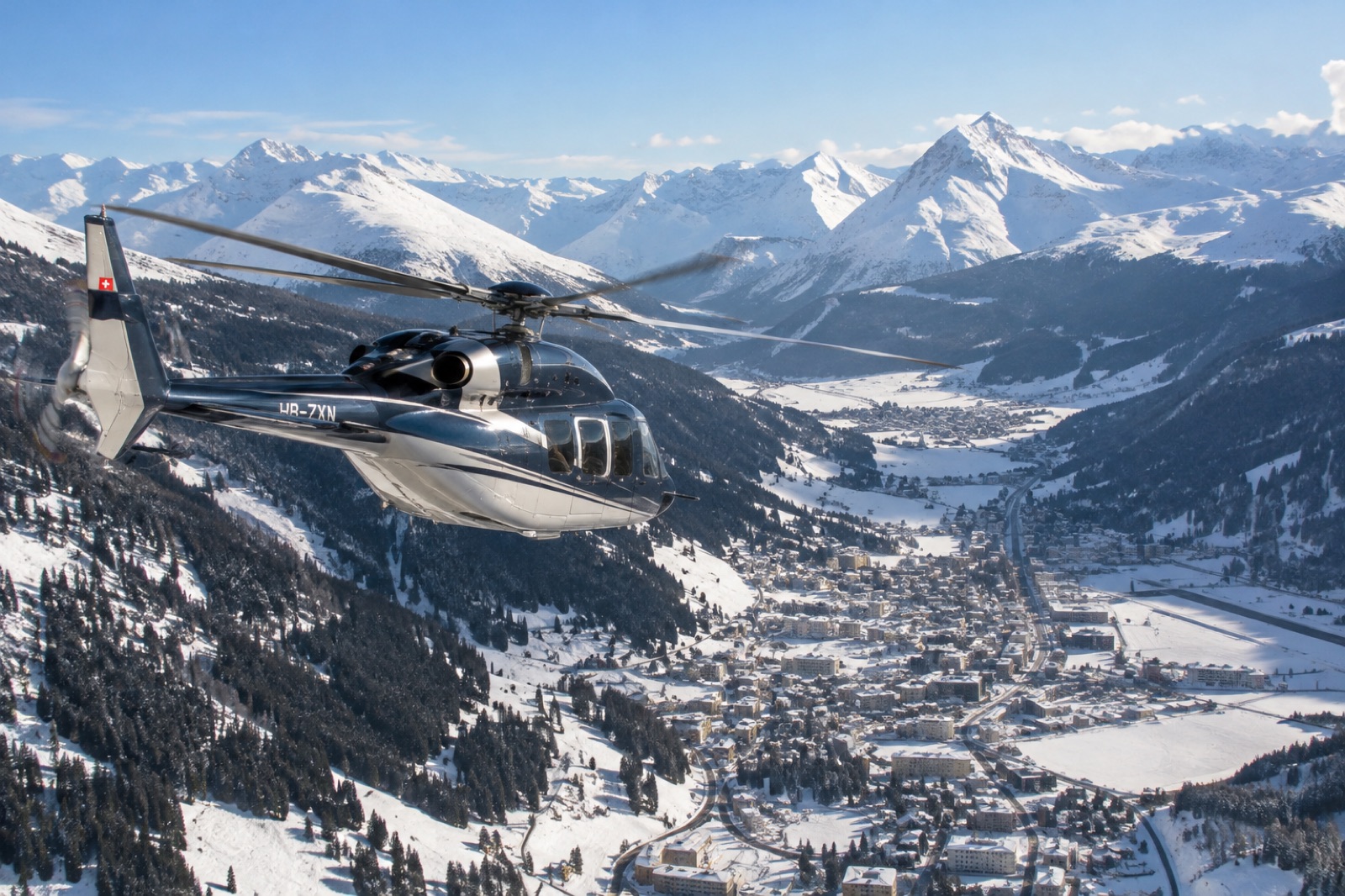
Davos has one temporary helicopter landing site for the Forum, by the lake, with six boarding positions and its own temporary control tower. Operators quote 20 to 40 minutes from Zurich. A foreign-registered helicopter needs a landing permission applied for at least ten days ahead, every operator needs the civil aviation office’s authorization and the Air Force accreditation, and every pilot in command needs a Swiss mountain rating. Military helicopters carry most of the protected persons; everyone else books a civil operator that holds the permissions, and books it early.
The sun sets in Davos a little after five in late January, earlier behind the peaks, and helicopter transfers depend on the weather. The road is the fallback: about 160 kilometers from Zurich Airport, a little over two hours in free-flowing traffic and longer in snow, with police checks of people, vehicles and luggage on every access road into Davos. The train, from Zurich Airport to Davos Platz with changes at Zurich and Landquart, takes about two hours forty, and it does not depend on the cloud base.

Samedan, and the Flüela pass
Samedan, the St. Moritz airport we described in our guide to the Alps for the holidays, sits inside the restricted area. A flight there needs both the airport’s own permission and the Air Force authorization, which are separate, and Zurich and Geneva may not be filed as alternates. Crews are asked to pass the airport’s own test first, a first visit in Forum week is discouraged, and for a large-cabin jet Samedan is rarely the answer. On the map Samedan looks close to Davos, but the direct road over the Flüela pass is closed in winter. The usual winter link is the Vereina car train, about 18 minutes through the tunnel, after an hour’s drive to the loading station.
Delegations and state aircraft
A government aircraft needs a Swiss diplomatic clearance, requested through the embassy at least five working days before the flight, which puts the latest date for a Monday arrival at Monday January 11. The 2026 regulations set three conditions: the handling agent and the parking must be confirmed before the clearance is requested, no clearance is issued without a clear parking arrangement, and Zurich stations at most one state aircraft per nation. A delegation that charters instead flies under the operator’s permits: a US charter operator needs its European third-country operator authorization and a Swiss permit. An individual permit covers up to three flights in three months and is requested at least 72 hours ahead; a longer chain, which a drop-off and repositioning plan can become, needs a Swiss operating permit requested at least 30 days ahead. Passengers from the United States complete their Schengen entry at the first Swiss airport, under the biometric checks we covered in our guide to Europe this fall.
From the East Coast, Teterboro to Zurich is about 3,410 nautical miles, comfortably inside the range of a Global 7500 or a Gulfstream G700. From Van Nuys it is about 5,140, a flight that can run past the ten hours a two-pilot crew may fly under Part 135, so it is planned with a third pilot.
What we tell our own clients
- Decide now where the aircraft spends the week, and request that parking with the flight, not after.
- Treat Zurich as the drop-off: a two-hour turn and, on last year’s rules, no landing before 2 p.m. local for a large-cabin jet without parking.
- Book the helicopter operator early: a foreign-registered helicopter needs its landing permission ten days ahead, and the Davos site has six boarding positions for the whole Forum.
- With parking arranged, land in the morning, so the transfer flies in daylight; without it, an afternoon arrival leaves about three hours before sunset, and the car or the train becomes the real plan.
- Avoid the Sunday before the Forum and the final Friday if the schedule allows; those are the peaks.
- For a delegation, file the diplomatic clearance only once parking and handling are confirmed.
The rest is what Trans World Jets does for the executive assistants and chiefs of staff who carry these weeks: the operator with its Swiss permits, the parking, the repositioning, the helicopter and the car behind it. For a delegation too large for one cabin, our VIP airliner guide covers the larger aircraft, and our UN General Assembly guide covers the other diplomatic week of the year. Write to sales@transworldjets.com or send the dates through our quote form.
Evan Grossman
Evan Grossman is the President of Trans World Jets, a private aviation brokerage based in Jupiter, Florida. With over two decades of experience arranging charter flights for corporate executives, families, and government clients worldwide, Evan specializes in complex logistics, medical evacuations, and VIP airliner charter. He founded Trans World Jets in 2011.
Planning your own charter?
Every mission is different. Reach out for a personalized quote from a broker who handles flights like these every day.