
Monaco's yacht show opens next week and Paris runs from Fashion Week to Art Basel. A broker's guide to the autumn 2026 European mission from South Florida: the EU's biometric border now running without its safety valve, why nobody files an ETIAS this season, the UK authorisation checked at boarding, the Le Bourget curfew, the ten-hour crew limit on the way back, and US preclearance at Shannon, with the South Florida airports that can receive it.

The Monaco Yacht Show opens on September 23. Paris follows with Fashion Week from September 28, the Arc on the first weekend of October, the motor show, then Frieze in London and Art Basel Paris at the Grand Palais in the last week of October. Between now and then a fair number of our clients will cross the Atlantic more than once, and the part of the trip that has changed since their last European summer is not the aircraft and not the airports. It is the border.
The biometric border, now without its safety valve
The EU’s Entry/Exit System has been fully operational since April 10 across 29 countries, and it replaced the passport stamp with a file. On a US passport’s first entry since then, the border police take a photograph and fingerprints, record the entry, and stamp nothing. Later entries are a verification, which is quicker. The 90-days-in-180 count is now computed automatically, as one period across all 29 countries. Refusing the biometrics means being refused entry, and children under 12 are registered without fingerprints.
What is new this month: through the summer, a temporary clause of the regulation let member states suspend the biometric registration when queues built up. That clause expired on September 6, and the Commission declined to extend it despite the airlines’ requests. As of this week, the trade press reports that France, Italy, Switzerland and several others are still running reduced procedures at some crossings. So plan for the full version, and treat anything less as a good day.
At a jet terminal the full version is manageable, provided it is planned. At Le Bourget the border police have worked the system from a mobile unit that comes ramp-side to the FBO, one unit for the seven FBOs on the field, at roughly two minutes per passenger when the systems behave; a standard business aircraft typically clears in five to twenty minutes. At Nice the business aviation terminal has its own customs post, but the self-service kiosks were still not in service this year, and returning passengers reported being fingerprinted again. Two consequences for whoever organizes the trip: the first European arrival of the season should not be scheduled against a hard appointment, and a passenger who travels on an EU residence permit, or under diplomatic accreditation, is outside the system and should say so before the aircraft lands, not at the desk.
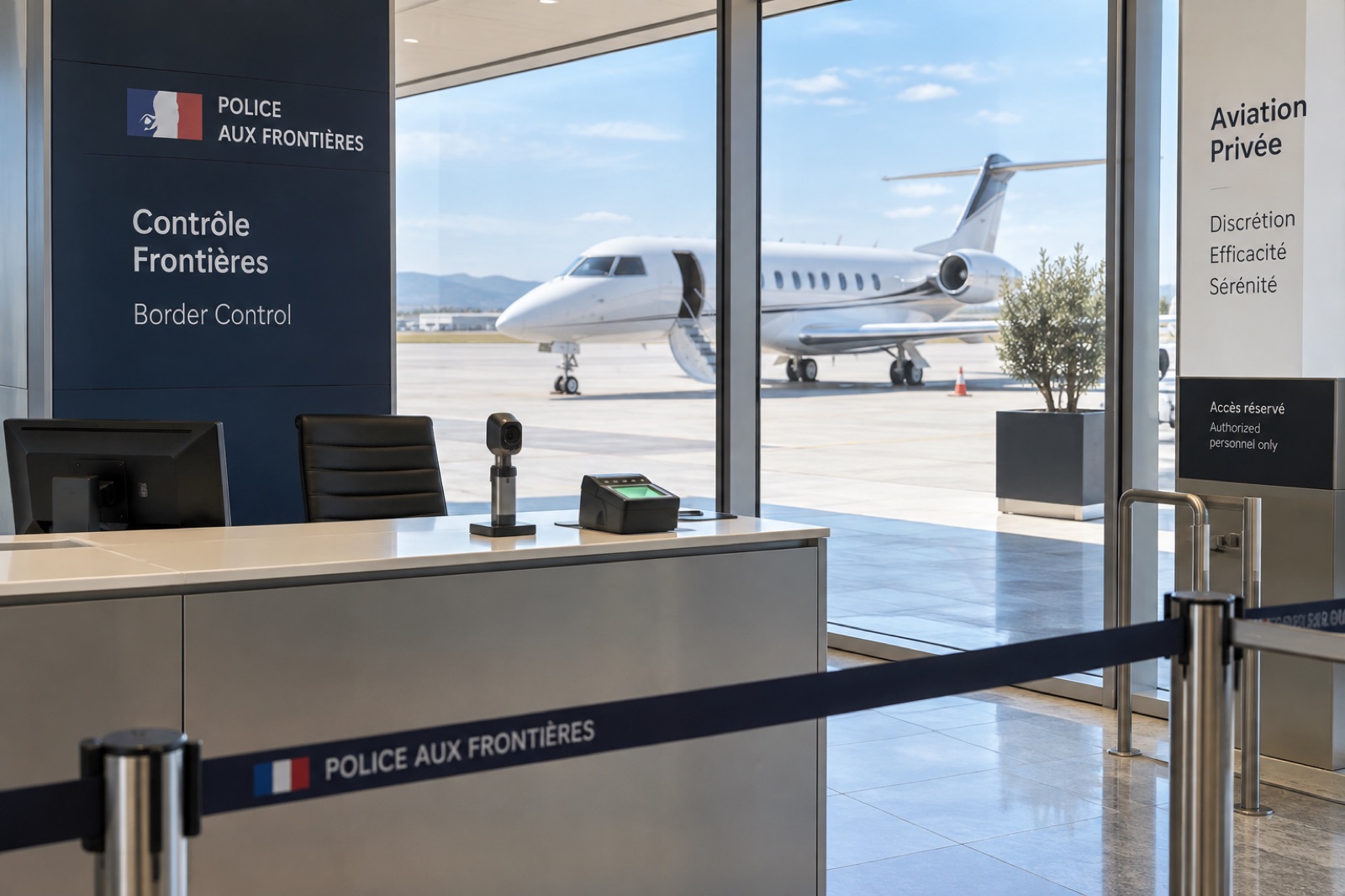
Nobody files an ETIAS this fall
Expect to be asked. ETIAS, the online travel authorization for visa-exempt nationals, US citizens included, was slated for the last quarter of 2026 for a long time. That wording came off the EU’s portal in July, and the Commission’s page now says the system is not in operation, that no applications are collected, and that the EU will announce the start date several months in advance. No new date exists. If a website, or a well-meaning intermediary, offers to file your principal’s ETIAS for a trip this autumn, that is the tell that something is off: the only legitimate channel will be the official site and app, when there is one. When it does arrive, it will be tied to the passport it was applied for and valid for three years, with a six-month transitional period during which it is not required. We will say so in this space when the date is real.
London runs the other way around
The United Kingdom is where the authorization is already real. The Electronic Travel Authorisation has been required of US citizens since January 2025, and since February 25 it is enforced before departure: the operator’s General Aviation Report to the Border Force returns each passenger’s permission status, and a passenger without a valid ETA or visa is not boarded. It covers multiple trips over two years, most applications are decided in minutes through the official app, the Home Office advises applying three working days ahead, and operating crew are exempt.
Frieze London runs October 14 to 18 in Regent’s Park. Farnborough, the airport most of our London clients use, is open from 7 a.m. to 10 p.m. on weekdays and from 8 a.m. to 8 p.m. at weekends, and nothing departs after midnight from Farnborough, Biggin Hill or Luton. A late dinner in London is followed by a morning departure.
The weeks that fill the ramps
Monaco first. The 35th Monaco Yacht Show runs September 23 to 26 in Port Hercule, with more than 120 superyachts on display. The show fills Nice, where slots are coordinated all year and, for a private flight, requested by the handling agent, and where any turnaround longer than four hours needs the airport’s approval. Cannes-Mandelieu keeps its 35-tonne weight limit, so the ultra-long-range jets that fly in from Florida land at Nice, and Monacair’s helicopter does the last seven minutes to Fontvieille. We wrote about the spring version of this corridor in May; the autumn version is shorter and calmer, and the same rules apply.
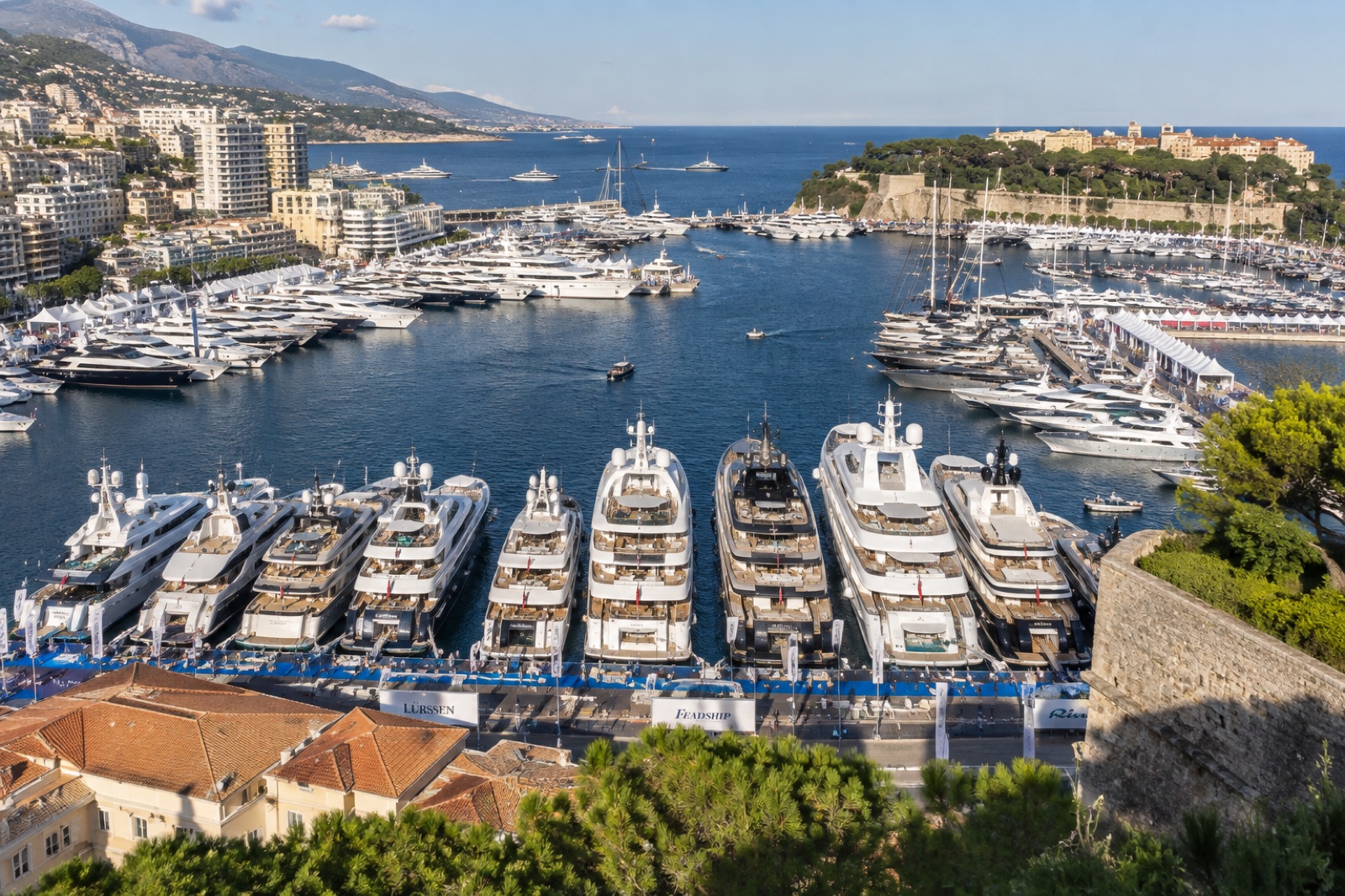
Then Paris, for a month: Fashion Week September 28 to October 6, the Qatar Prix de l’Arc de Triomphe at ParisLongchamp on October 3 and 4, the motor show at Porte de Versailles from October 13 to 18, and Art Basel Paris at the Grand Palais October 23 to 25, with previews on the 21st and 22nd. Le Bourget takes arrivals around the clock, but jet departures are prohibited between 10:15 p.m. and 6 a.m., with pre-approved medevac the only exception, so the evening flight home after a vernissage leaves before a quarter past ten or the next morning. The parking approval is bound to the schedule that was filed, and a changed departure time can lapse it. The general declaration includes each passenger’s place of birth, a detail worth collecting with the passports.
The way there, and the day that binds
From West Palm Beach it is about 3,930 nautical miles to Le Bourget and 4,200 to Nice. On paper every ultra-long-range type covers that with room to spare: the Gulfstream G700 and G800, the Global 7500 and the Global 8000, which entered service last December, the Falcon 8X, and the G650ER, out of production since last year with hundreds still in service. The G600 and Global 6500 fly it too; a Challenger 650 does it with a stop. Eastbound the jet stream helps, and Miami to Paris is commonly quoted at eight and a half to nine hours. Westbound, against the same wind, the same leg runs nine to ten hours, and that is the day that binds.
The reason is the crew, not the fuel. Under Part 135, a two-pilot crew may fly ten hours in any 24, so a nine-and-a-half-hour westbound leg sits on the limit with no allowance for a hold, a reroute or a stronger headwind than forecast. Beyond that, the flight is planned with three pilots, each limited to eight hours on the flight deck, the aircraft to twelve hours aloft, and a proper rest facility on board for the relief pilot. That decision is made before departure, on the forecast winds, and it is one of the questions we put to the operator when we source a westbound flight in autumn.
Coming home through Shannon
There is a second way to build the westbound day. US Customs and Border Protection runs preclearance at Shannon for private and charter flights: passengers and crew present themselves to CBP in Ireland, and the aircraft then lands in the United States as a domestic flight, at any of more than 200 approved airports, with no inspection on arrival. The FBO books the appointment and the manifest is filed at least 24 hours ahead, appointments run from 7 a.m. to 9 p.m. local, and a fuel stop with preclearance turns in 45 minutes to an hour. Since January 1, charter passengers go through the main terminal’s security screening before entering the CBP area, so the stop is less private than it was. And a diversion for any reason, weather included, voids the preclearance: the aircraft then clears at its first US landing.
The destination has to be chosen for it. In South Florida, CBP’s August list marks West Palm Beach, Fort Lauderdale Executive and Boca Raton as eligible for precleared arrivals, and Opa-locka as not. Without preclearance, the arrival airport’s own CBP hours apply: West Palm Beach inspects daily until 7:30 p.m., Opa-locka and Fort Lauderdale Executive until close to midnight, and Boca Raton only Thursday to Monday, with no officers on Tuesdays and Wednesdays. Permission to land is requested before the aircraft leaves Europe, and the electronic manifest is filed at least an hour before departure.
One administrative note for whoever files the paperwork: Palm Beach International was renamed President Donald J. Trump International Airport in July, its IATA code changed from PBI to DJT on August 18, and CBP’s own documents now carry the identifier KDJT. Flight plans, manifests and permission requests should use the new one.
What we tell our own clients
- Every passport on the manifest is a first EU entry until it has been enrolled. Plan the first arrival of the season with margin, not against a meeting.
- Nobody files an ETIAS this year. An offer to do so is the tell.
- Westbound in autumn, ask whether the flight is planned with two pilots or three before you ask anything else.
- If the way home runs through Shannon, choose the Florida airport for it, and book the stop 24 hours ahead.
The rest is what Trans World Jets does: the aircraft, the crew qualifications, the handler at Nice or Le Bourget, and the cars at both ends. Write to sales@transworldjets.com or send the trip through our quote form, and start with the dates.
Evan Grossman
Evan Grossman is the President of Trans World Jets, a private aviation brokerage based in Jupiter, Florida. With over two decades of experience arranging charter flights for corporate executives, families, and government clients worldwide, Evan specializes in complex logistics, medical evacuations, and VIP airliner charter. He founded Trans World Jets in 2011.
Planning your own charter?
Every mission is different. Reach out for a personalized quote from a broker who handles flights like these every day.