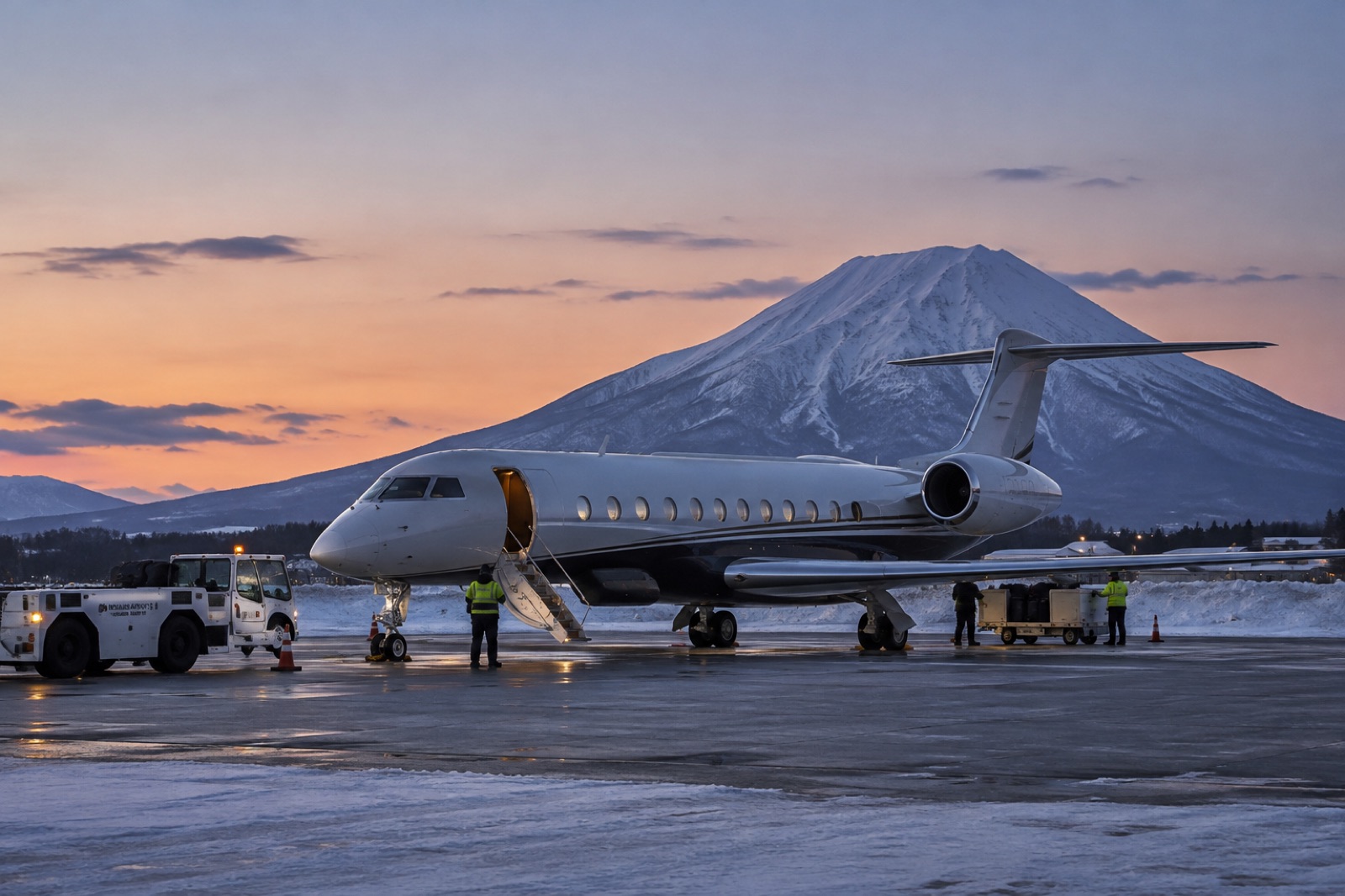
Planning a Christmas or New Year charter to Niseko: New Chitose's winter ban on overnight parking outside, which large-cabin jets fit its one hangar, repositioning to Narita, Japan's permits and slots, and the crew for the long leg.

Niseko has become one of the most sought-after winter destinations for families who fly privately. The snow is famous, Grand Hirafu is scheduled to open on November 28, 2026, and night skiing across the four Niseko United resorts is planned from December 12. For a family flying from New York, Palm Beach or Los Angeles for Christmas or New Year, it is also one of the most demanding holiday trips to plan, and almost none of the difficulty is in the flight itself. It is in where the aircraft spends the week.
This guide covers what we settle in October and November for a Niseko holiday on a large-cabin jet: the winter rule at New Chitose, the one hangar and the aircraft it accepts, Japan’s permits and slots, the crew for the long leg, and the last stretch to the mountain.
New Chitose’s winter rule
Niseko is served by New Chitose, the airport for Sapporo, about 110 kilometers away by road. It is a capable airport, with two runways of 9,840 feet, and since December 2023 it has had a dedicated terminal for business aircraft, the Hokkaido Business Aviation Center, with its own customs and immigration area. Passengers arrive, clear in privately and are in the car within minutes.
The aircraft is another matter. The airport operator’s own regulations state that from December 1 to March 31, aircraft are not, in principle, permitted to park outside overnight, defined as 10 p.m. to 8 a.m. The ramp has to be cleared of snow. A Japanese handler’s guidance to operators puts it more bluntly: no overnight parking from December to March, drop the passengers and reposition the aircraft. The same guidance asks business aircraft to be airborne by 9:50 p.m., local time.
For a family on a two-week holiday, this means the jet does not wait at the airport. Either it goes into the one hangar on the field, or it leaves.
The one hangar, and the jets it does not fit
New Chitose has a single hangar for business aircraft, and its rules are specific. It holds one aircraft at a time. A booking covers at most six nights, aircraft move in and out only between 8 a.m. and 10 p.m., and passengers board on the ramp, never inside. The request goes through the operator’s flight support company together with the slot request, has to be submitted on the airport’s portal at least 72 hours ahead, and stands only once the airport confirms it. A confirmed booking cannot, in principle, be shortened.
The published list of eligible aircraft matters most. It includes the Gulfstream G650 and G650ER, the G600 and the earlier Gulfstreams, the Global 6500 and the rest of the Global 5000 to 6500 family, and the Falcon 6X. It does not include the Gulfstream G700, the G800, the Global 7500 or the Global 8000: the parking bay inside is 30.4 meters wide, just under 100 feet, and the wingspans of those four aircraft run to about 103 and 104 feet. The Falcon 8X and the VIP airliners are not on the list either. The airport can make exceptions, but we do not plan a holiday around one.
So the choice of aircraft and the choice of parking are the same decision. A G650 can stay in Hokkaido for up to six nights if the hangar is free, and only one aircraft can have it. A longer stay is possible only if the hangar is still free and the airport agrees, which we do not count on at New Year. With the newest flagships, and with any stay longer than six nights, the plan is repositioning.
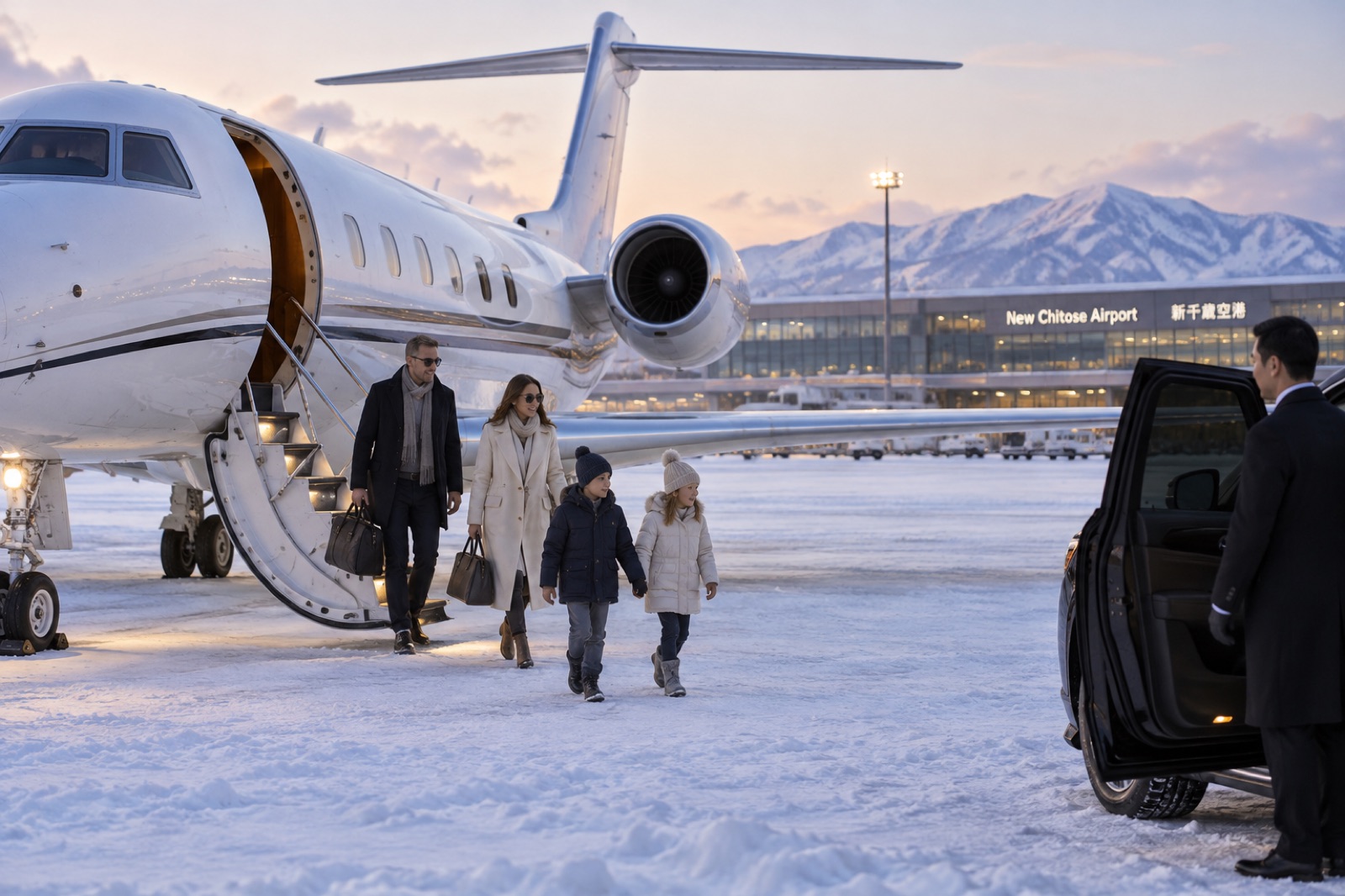
Repositioning to Narita, and what it costs in time
The standard answer is to fly the empty aircraft to Tokyo. Narita is about 425 nautical miles from New Chitose and has much more room for business aircraft than Haneda, which limits a stay to five days in total, with no exceptions. Narita has a curfew: nothing moves after midnight, and the hours from 11 p.m. need a noise certificate filed in advance.
Repositioning adds two flights to the plan, and two slots, and the empty legs and the crew’s stay in Tokyo go into the permit, slot and handling requests at the start, not on the day. The aircraft has to come back to New Chitose with its crew rested and land within its slot on the morning the family leaves. A heavy snowfall on Hokkaido or a de-icing queue can push that arrival back. On departure day, we build in a margin: the family leaves the chalet only once the aircraft is confirmed inbound, and the lounge at the business terminal does the waiting.
Some families combine Niseko with a few days in Tokyo, and the order makes a difference. Japan allows a domestic leg on a charter only when the passengers arrived from abroad on the same aircraft or will leave on it, and that leg needs its own application. Arriving in Tokyo first means the long crossing ends at an airport where the aircraft can park, and the crew rests before the short flight north. We apply for every leg at the start.
Permits and slots
Japan requires a landing permit for every charter flight, with a typical lead time of about three business days, and slots are mandatory at the major airports, New Chitose included. Neither is difficult in itself. The pressure is the calendar: New Year is one of Japan’s peak travel periods, and Hokkaido’s ski season is another. For Tokyo in high season, the specialists’ advice is to request slots 30 days or more ahead; at 72 hours, the times are effectively fixed. For a Christmas arrival that means the plan is settled in November.
US passport holders need no visa for a short stay, but household staff, a nanny or a security detail traveling on other passports may. Japan has passed a law for an electronic travel authorization, JESTA, but it is not expected before 2028 and changes nothing this winter. Passports should be valid for the whole stay, and any traveler who does need a visa must have it before departure, since Japan does not issue them on arrival.

The long leg
From New York, New Chitose is about 5,400 nautical miles by the shortest route, within the range of a G650ER, a G700 or a Global 7500, and a westbound winter flight of around twelve hours or more against the winds. Of those three, only the G650ER is on the hangar list. All three are certified above the 100,000-pound limit at Teterboro, so a departure from there carries less fuel; depending on the aircraft, the load and the winds, that can mean a fuel stop or another New York-area airport, as our Thanksgiving guide explains. From Palm Beach it is about 6,000 nautical miles, a nonstop only for the longest-range jets.
A flight of that length is beyond the 10 hours a two-pilot charter crew may fly under the FAA’s Part 135 rules, so the aircraft carries an augmented crew of three or four pilots, depending on the planned time aloft, and a proper crew rest area. From Van Nuys, it is about 4,400 nautical miles, and the westbound crossing usually flies into the winter jet stream, close to or beyond that 10-hour line. A heavy jet with less range can stop at Anchorage, about 2,600 nautical miles short of Hokkaido, but the stop does not reset the crew’s clock: it needs an augmented crew or a night’s rest there.
The crew’s duty day shapes both ends of the stay in Japan. On arrival, a crew that has just crossed the Pacific must still have time left within its limits to fly on to Narita before New Chitose’s evening cutoff and Narita’s curfew; if it does not, the aircraft needs the hangar for that first night. On the way home, the empty flight from Narita counts in the same duty period as the ocean crossing, so the pickup time in Hokkaido is set by the crew’s limits and the slots, not only by when the family wants to leave.
The last two hours
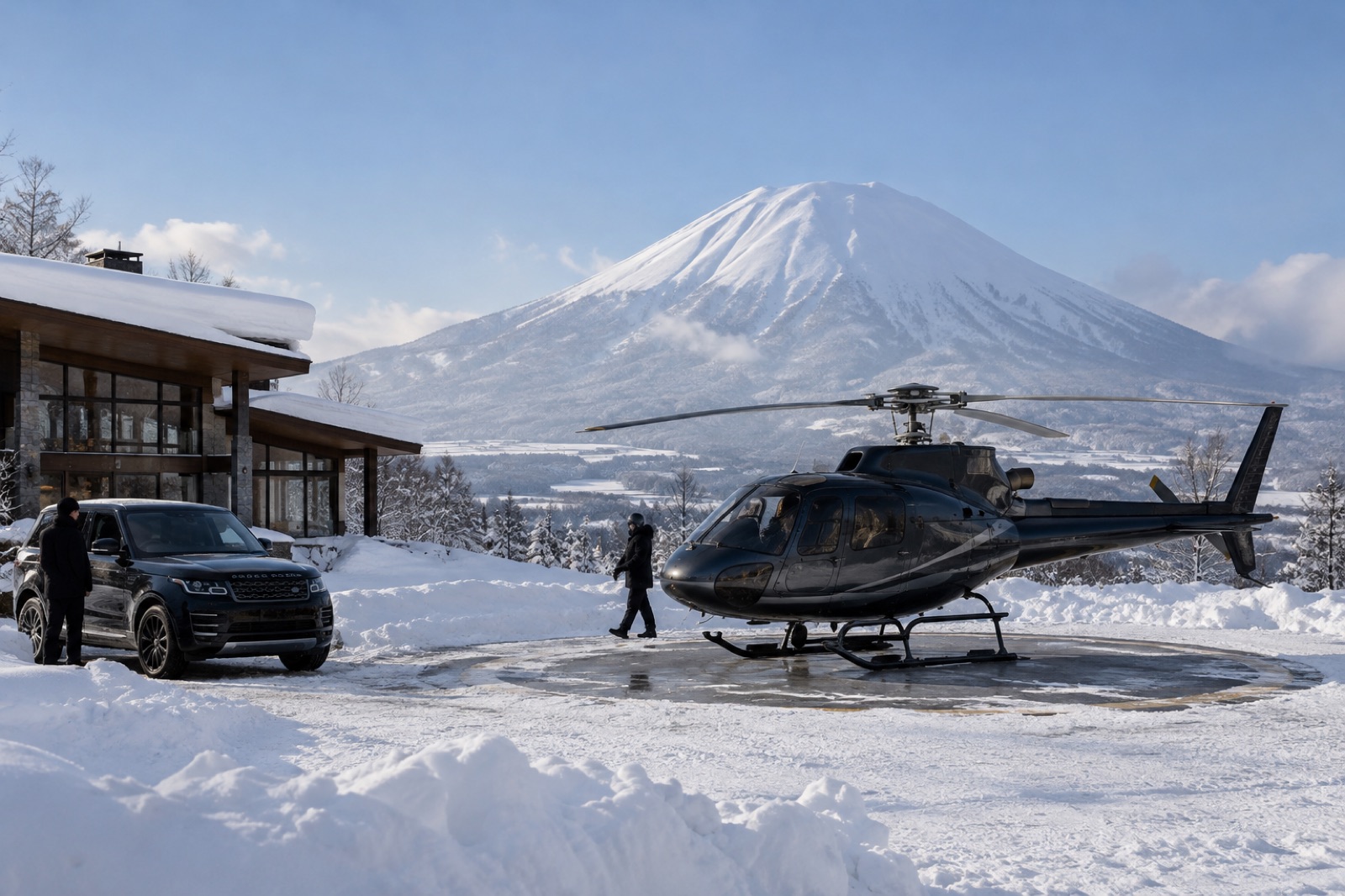
From New Chitose to Niseko is two and a half to three and a half hours by road in winter, depending on the snow. A helicopter makes it in about half an hour, and services operate from New Chitose, but winter weather decides. At the Niseko Heliport, 8 of the 18 reservations made in January 2026 were cancelled because of the conditions, and helicopters fly in daylight, which ends around 4 p.m. in Hokkaido in late December. We book the car as well, every time: it carries the ski bags in any case, and it is the plan when the sky says no.
The best snow usually comes from early January to late February, and the finest chalets in Hirafu are reserved long before. Families who fly for New Year meet Japan’s own holiday peak at the same moment, which is one more reason to start now.
For a family that also skis in Europe, our guide to the Alps for the holidays covers Courchevel, Gstaad, St. Moritz and Verbier, and our Aspen guide covers the Rockies. If you plan travel for a principal, our field guide for executive assistants and family offices explains what we ask for at the start.
Planning Niseko with Trans World Jets
A Niseko holiday works when four decisions are made together and early: the aircraft, where it waits, the slots for every leg, and the crew for the long flight. We settle them in that order, with operators experienced in Japan, and we tell you plainly when the newest jet is not the best choice for the week.
To start planning Christmas or New Year in Niseko, request a quote or write to us at sales@transworldjets.com.
Evan Grossman
Evan Grossman is the President of Trans World Jets, a private aviation brokerage based in Jupiter, Florida. With over two decades of experience arranging charter flights for corporate executives, families, and government clients worldwide, Evan specializes in complex logistics, medical evacuations, and VIP airliner charter. He founded Trans World Jets in 2011.
Planning your own charter?
Every mission is different. Reach out for a personalized quote from a broker who handles flights like these every day.