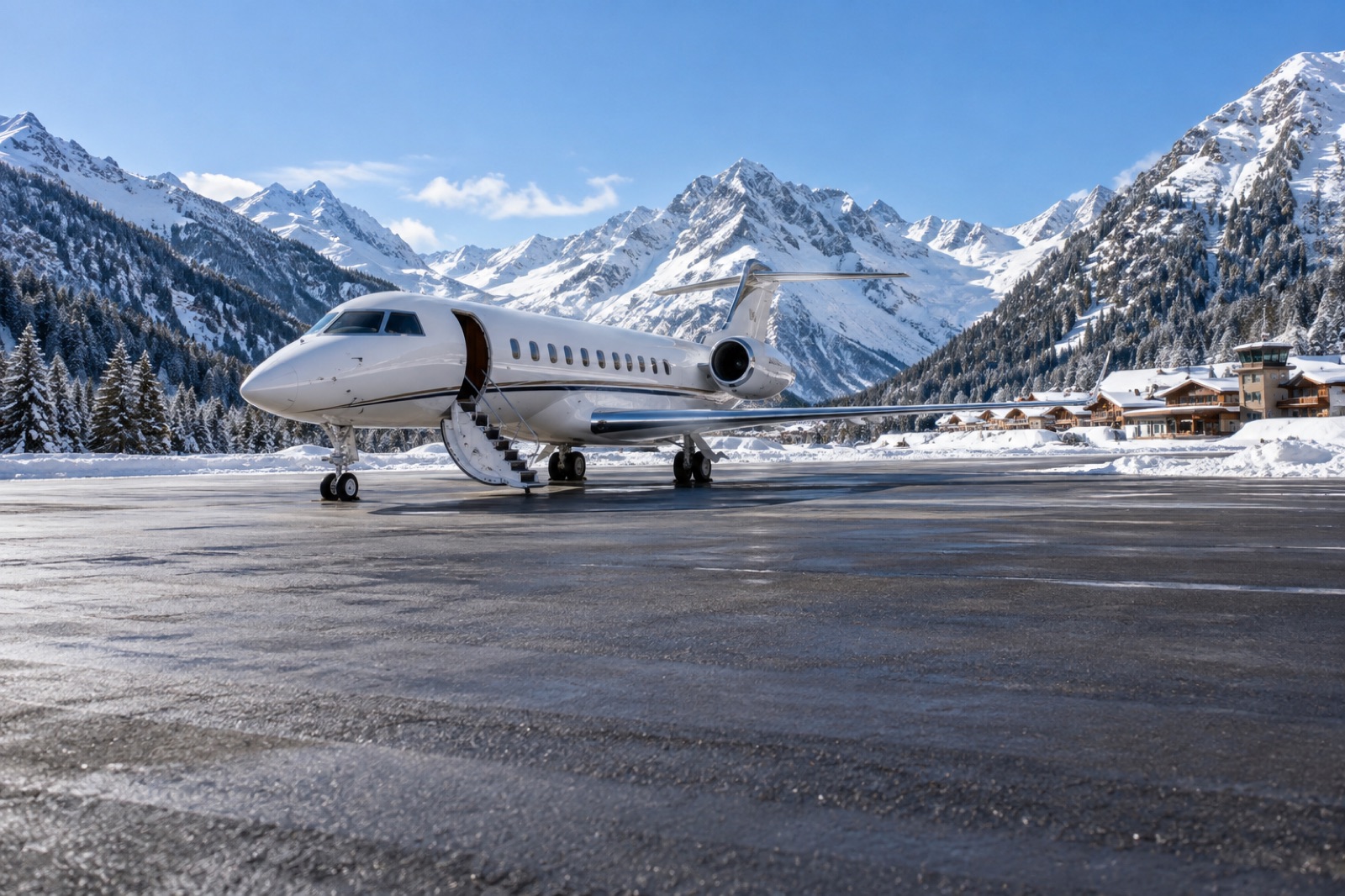
The large-cabin jet rarely lands at the resort. A broker's guide to Christmas and New Year in the Alps: Geneva's Saturdays and five-day permission window, Chambéry's weekend cap and the Courchevel helicopter, Samedan's daylight-only runway for St. Moritz, Sion for Verbier and Zermatt, and why the last miles are planned around a sunset just before five.
Christmas falls on a Friday this year, and so does New Year’s Day. In the Alps that puts the pressure on three Saturdays, December 19, December 26 and January 2, when the resorts change over and the airports below them fill. For a family heading to Courchevel, Gstaad, St. Moritz or Verbier from the United States, the transatlantic leg is the easy part: Teterboro to Geneva is about 3,350 nautical miles, well inside the range of any large-cabin jet. What decides the holiday is where that jet is allowed to land, and how the party covers the last miles up the mountain before the light goes.
Geneva: the gateway, and its Saturdays
Geneva is where most holiday parties for the French and western Swiss Alps arrive. Every business aviation flight there needs a prior permission number, the window opens only five days ahead, and the handler books it. Private flights operate between 6 a.m. and 10 p.m. The airport’s own slot report for last winter shows how the week is shaped: the runway was 61 percent used on weekdays, 80 percent on Sundays and 85 percent on Saturdays. On last winter’s figures, a party that can arrive on a Thursday or a Friday lands at a quieter airport than the one that fills on a Saturday.
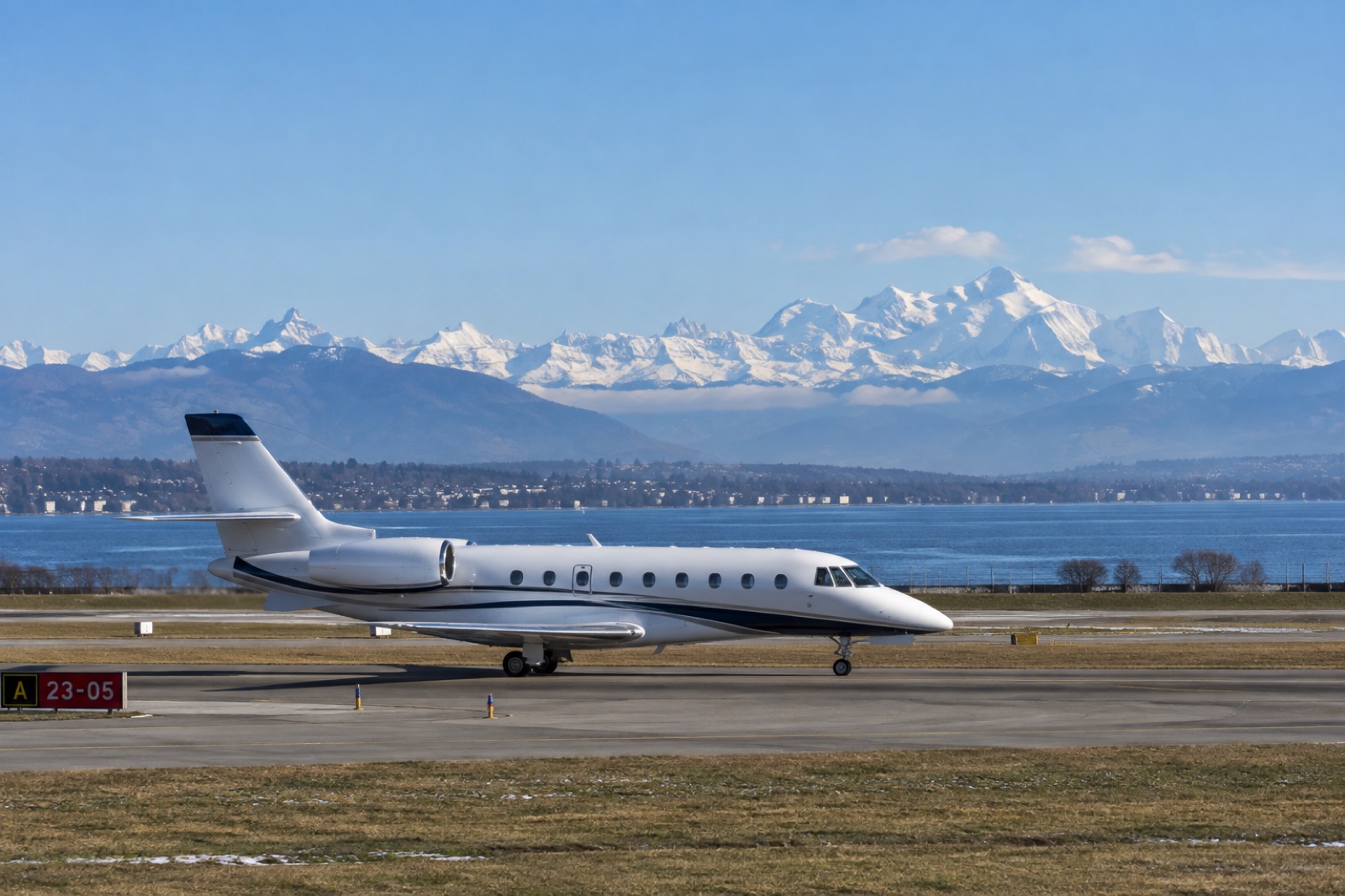
Geneva also has a French sector, and it is often misunderstood. Switzerland and France are both in the Schengen area, so a party arriving from the United States completes its Schengen entry in Geneva either way, under the biometric checks we described in our guide to Europe this fall. The French sector separates customs, not immigration, and the FBOs clear French customs on site for a party driving or flying on to Courchevel or Megève.
Courchevel: the altiport is not for the jet
The Courchevel altiport is a 537-meter strip at about 2,000 meters, on a slope of roughly 18 percent. Aircraft land uphill and take off downhill whatever the wind, in daylight only, and the pilot needs a qualification specific to the site. No business jet lands there; the resort lists a single airline authorized to carry passengers in, flying small turboprops of the PC-12 type.
The large-cabin jet goes to Geneva or to Chambéry, which has a 2,020-meter runway, fire cover up to category 6 on request, and a winter regime worth knowing. Every flight needs a prior permission request. On winter weekends arrivals are capped at five an hour. Overnight parking from Friday to Sunday is limited and studied case by case, and there is no hangar. Unused slots are released ten days before arrival to operators on the waiting list, and a request Chambéry cannot accept is moved to Grenoble or Lyon. France also wants the passenger and crew list 24 hours before any arrival.
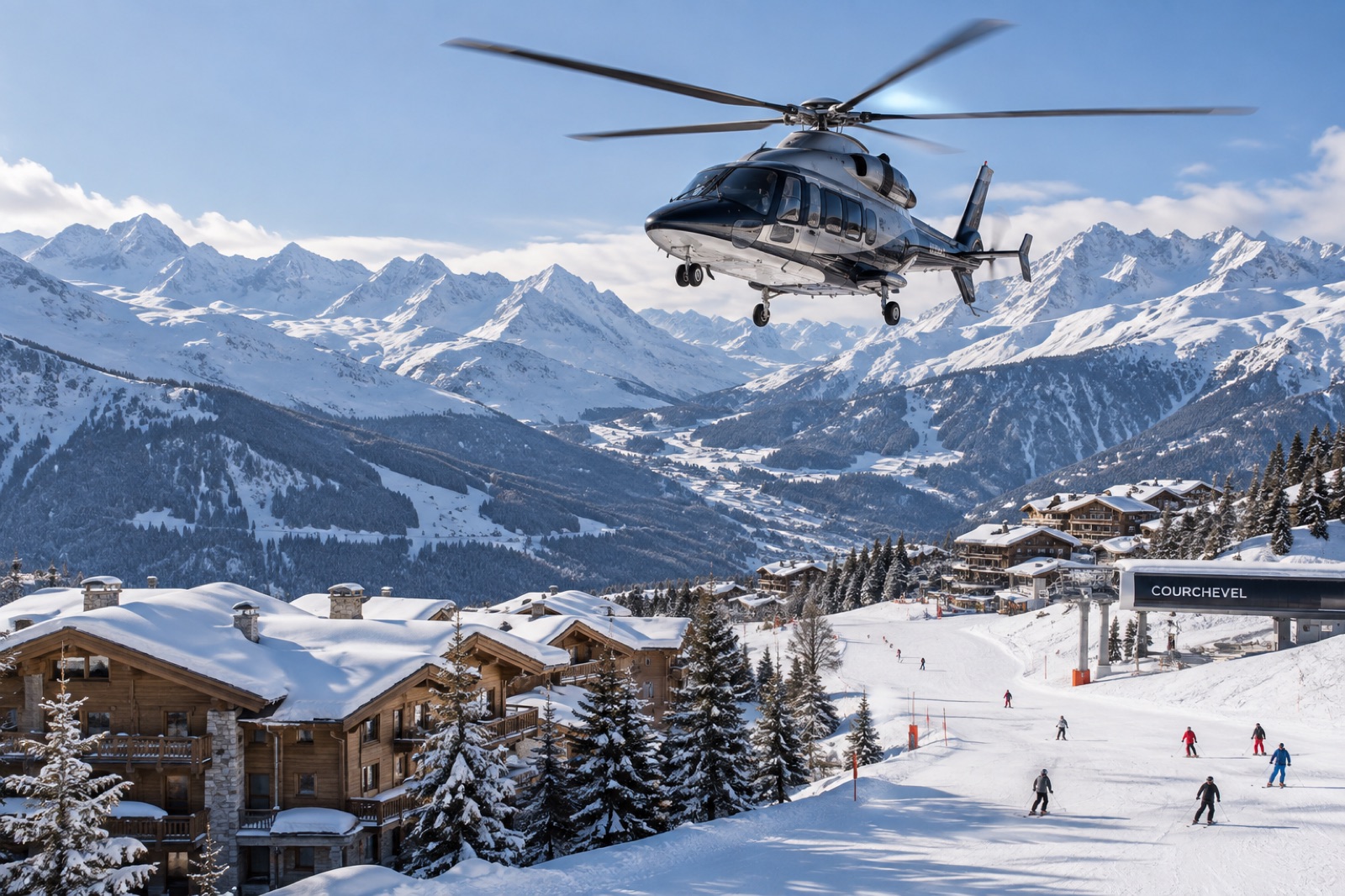
From Chambéry the helicopter reaches Courchevel in about 15 minutes, by the airport’s figure; from Geneva the flight is about 30 to 35 minutes. The road from Geneva takes about two hours on a normal day, and the valley has essentially one main road, the N90 through Moûtiers, which slows to a crawl on changeover Saturdays and was closed by a rockslide in February 2025. The helicopter is the plan; the road is the fallback, and it should be booked as one.
St. Moritz: Samedan, by daylight only
Engadin Airport at Samedan sits at 1,707 meters, five minutes from the slopes, with a runway of about 1,800 meters. It has no runway lights and no night operations. In winter it opens at 8 a.m. and closes 30 minutes after sunset, which around the solstice means a little after five in the afternoon. Every pilot must complete the airport’s own briefing and test, renewed each year for faster aircraft, and arrivals stop when visibility falls below five kilometers or the cloud base below 2,200 feet. Apron space is tight over Christmas and New Year.
The municipality describes the airport as open to jets “up to medium-weight.” At that elevation a heavy jet is planned case by case, with the payload and fuel the operator can accept on the day, and with Zurich as the realistic alternative, two and a half to three hours away by road. For a Global 7500 or a Gulfstream G700, the honest plan is often Zurich and a helicopter or car, with Samedan as the bonus when the weather and the ramp allow.
Verbier, Zermatt and Gstaad: Sion
For the Valais, Sion is the strongest gateway: a 2,000-meter runway, customs and immigration, and de-icing guaranteed from November to April. Its instrument approach starts at six degrees, twice the usual angle, and every crew flying it needs a local qualification; the version that allows lower minima and night operations is earned on a flight there or in an approved simulator, and the approved centers include FSI in Teterboro and CAE in Las Vegas. It stays valid twelve months from the last landing at Sion, so the question for the operator is simple: does this crew hold the Sion qualification for lower minima, and has it landed at Sion in the past twelve months?
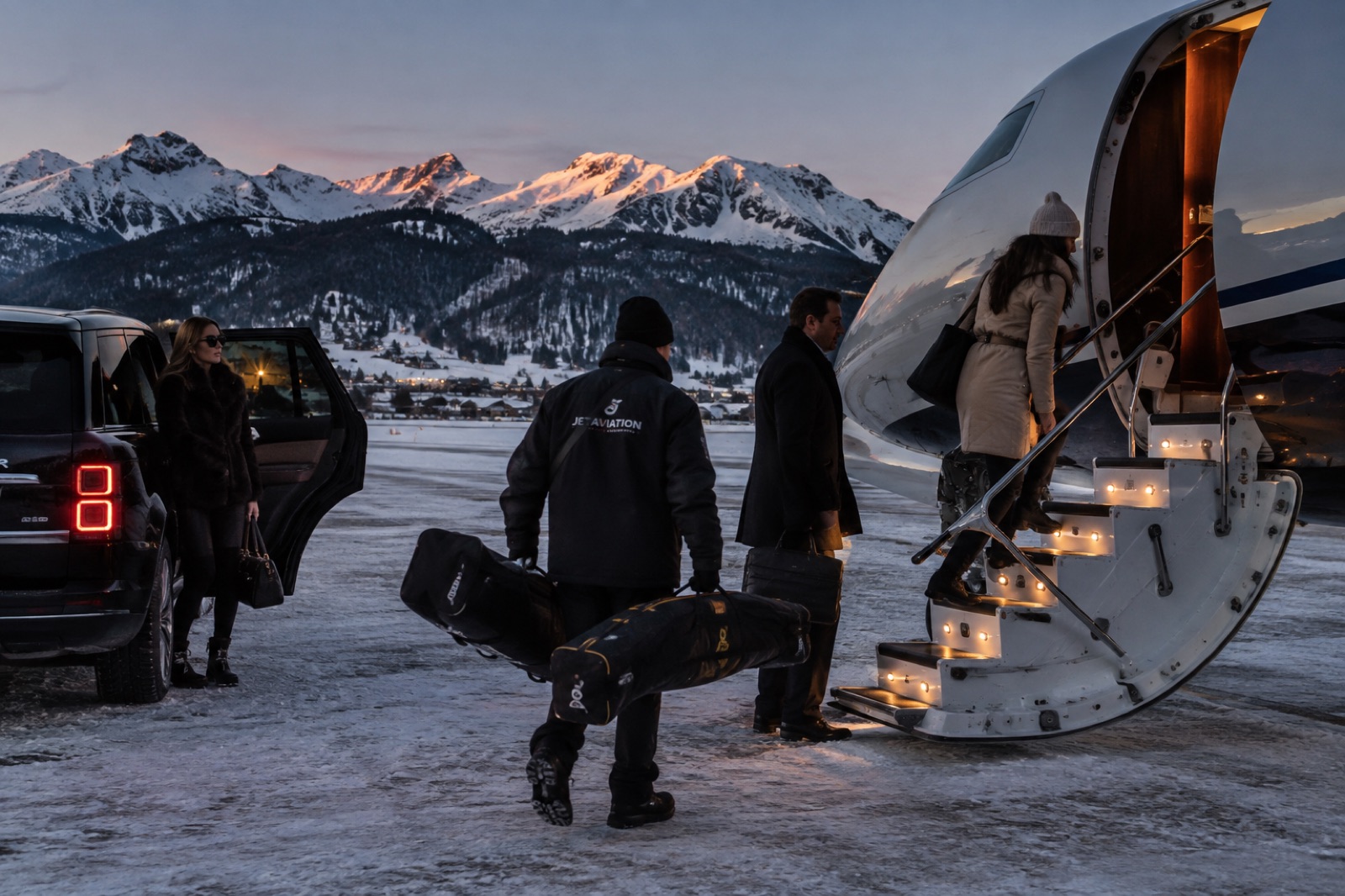
From Sion the helicopter reaches Verbier in about 15 minutes, Zermatt in about 20 and Gstaad in about 15. Zermatt is car-free: by road, cars stop at Täsch and a shuttle train covers the last five kilometers. Gstaad has its own airfield at Saanen, but with about 1,000 meters of landing distance it takes turboprops and light jets, not a large cabin; Sion, Bern and Geneva are the jet airports for Gstaad.
The light, and the last miles
The sun sets around 4:45 p.m. in the Alps in late December, and earlier behind the peaks. The mountain airfields, Samedan, Saanen and the altiports, work to that limit, and the helicopter transfers are flown in daylight and in reasonable weather; low cloud or wind turns them into road transfers. A party that lands in Geneva at 3 p.m. on December 19 is racing the sunset on a changeover Saturday, the first day of the French school holidays. A morning arrival, or a day earlier, takes the race out of it.
From the West Coast the picture changes. Van Nuys to Geneva is about 5,100 nautical miles, a flight for an ultra-long-range jet that can run past the ten hours a two-pilot crew may fly under Part 135, so it is planned with a third pilot.
What we tell our own clients
- Choose the resort’s airport first, then the aircraft: Courchevel means Chambéry or Geneva and a helicopter, St. Moritz means Samedan by daylight or Zurich, Verbier and Zermatt mean Sion.
- Avoid arriving on December 19, 26 or January 2 if the dates allow; a Thursday or Friday is a different airport.
- Land in the morning, so that the helicopter flies in daylight and the road remains a fallback, not the plan.
- For Sion and Samedan, ask whether the crew holds the local qualification or briefing before the aircraft is confirmed.
- For Chambéry, the weekend slot and the overnight parking are requested with the flight, not after.
The rest is what Trans World Jets does, and what an executive assistant should not have to chase: the operator and crew qualified for the airport, the slot and the parking, the helicopter and the car behind it. If the holidays split between the Alps and the Caribbean or Colorado, our guides to St. Barths and Aspen cover the other halves. Write to sales@transworldjets.com or send the dates through our quote form.
Ryan Curtis
Ryan Curtis is the Vice President of Trans World Jets, overseeing charter operations, aircraft sourcing, and client relationships. With over two decades in private aviation brokerage, Ryan focuses on matching clients with the right aircraft for missions ranging from last-minute business travel to multi-leg international tours. He works alongside his brother Evan at Trans World Jets in Jupiter, Florida.
Planning your own charter?
Every mission is different. Reach out for a personalized quote from a broker who handles flights like these every day.