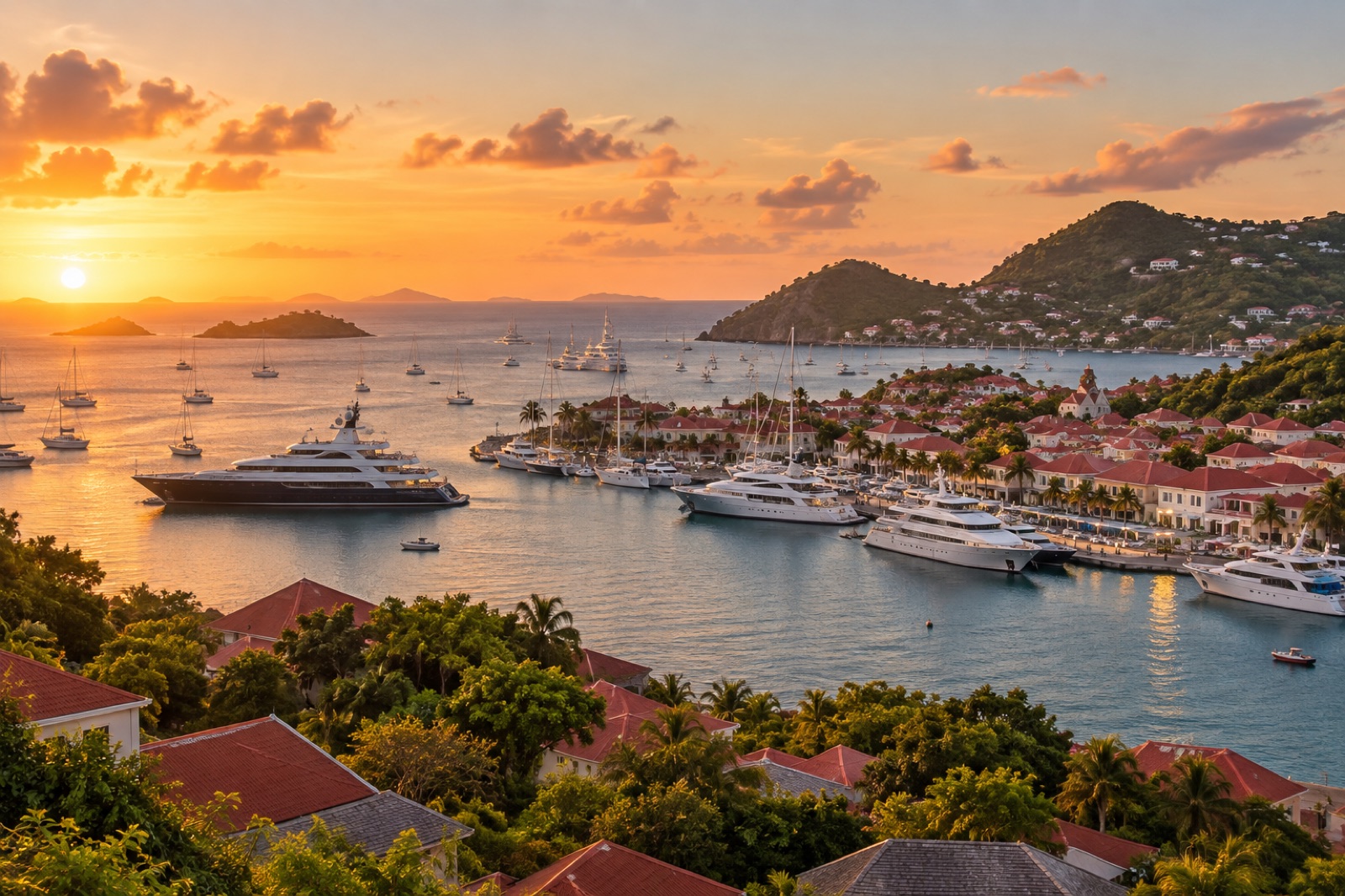
No business jet can land at St. Barths, so Christmas on the island is two flights: a large-cabin jet to St. Maarten, San Juan or Antigua, then seventeen nautical miles in a turboprop onto a 2,119-foot runway that ends on a beach and closes at sunset. A broker's guide to the 2026-27 season: the airport's new winter regime rationed by parking stands, the hourly cap, the field's own rules, the three relay airports, the sea and helicopter options, and the papers, EES included, on the way in and the way home.
The runway at St. Barths is 2,119 feet long and ends on a beach. Nothing our clients cross the Atlantic or the Caribbean in can land on it, and that single fact shapes the whole trip: the aircraft that leaves Teterboro or West Palm Beach lands at St. Maarten, San Juan or Antigua, and the last seventeen nautical miles are flown by a turboprop, onto a hill, at a field that closes fifteen minutes after sunset. This winter that field also runs under a new regime, rationed by parking stands, with a cap on private movements per hour. The villas over Christmas carry ten to fourteen night minimums and are taken a year ahead, the berths in Gustavia for New Year’s Eve are committed twelve to eighteen months out, and the airport’s winter season opens on October 25. As with Aspen, the conversation for December happens in September.
What changed at the airport this year
Last winter Gustaf III airport ran a trial of what the French civil aviation authority calls schedules facilitation, because, in its own words, the field’s installations were saturated. In June the authority wrote to COHOR, the Paris slot coordinator, that the saturation will persist and that the arrangement is to become permanent: for the 2026-27 season, from October 25 to March 27, every commercial and business rotation into St. Barths is facilitated by COHOR, requested in the airline slot format through the operator’s handling agent. What is rationed is not the runway but the ground: ten aircraft stands and two helicopter stands during the day, twelve and two overnight, one aircraft per stand. From October 1, a single stand is held back for requests made inside five days of the flight. Everything else is allocated in advance.
The numbers behind the decision are public. In 2025 the airport handled 47,805 movements and 232,535 passengers, and on January 2, 3 and 4 of this year it counted 315, 347 and 269 movements in a day, on a field with ten daytime stands. Since January 4 a further rule caps private, non-scheduled arrivals at four an hour, with the authority able to bring that to two, because the airspace around San Juan, which feeds the island, was itself congested. The president of the territory said in January that he is not sure the airport can grow further, and that the aim is to spread the traffic, not add to it. For anyone organizing a Christmas trip the consequence is simple: the last hop is booked at the same time as the jet, with the handler’s request into COHOR, not after the villa is confirmed. Parking for any non-based aircraft is on prior permission, 48 hours ahead, all year, and a daytime turnaround on the main apron may not exceed 20 minutes.
The field itself
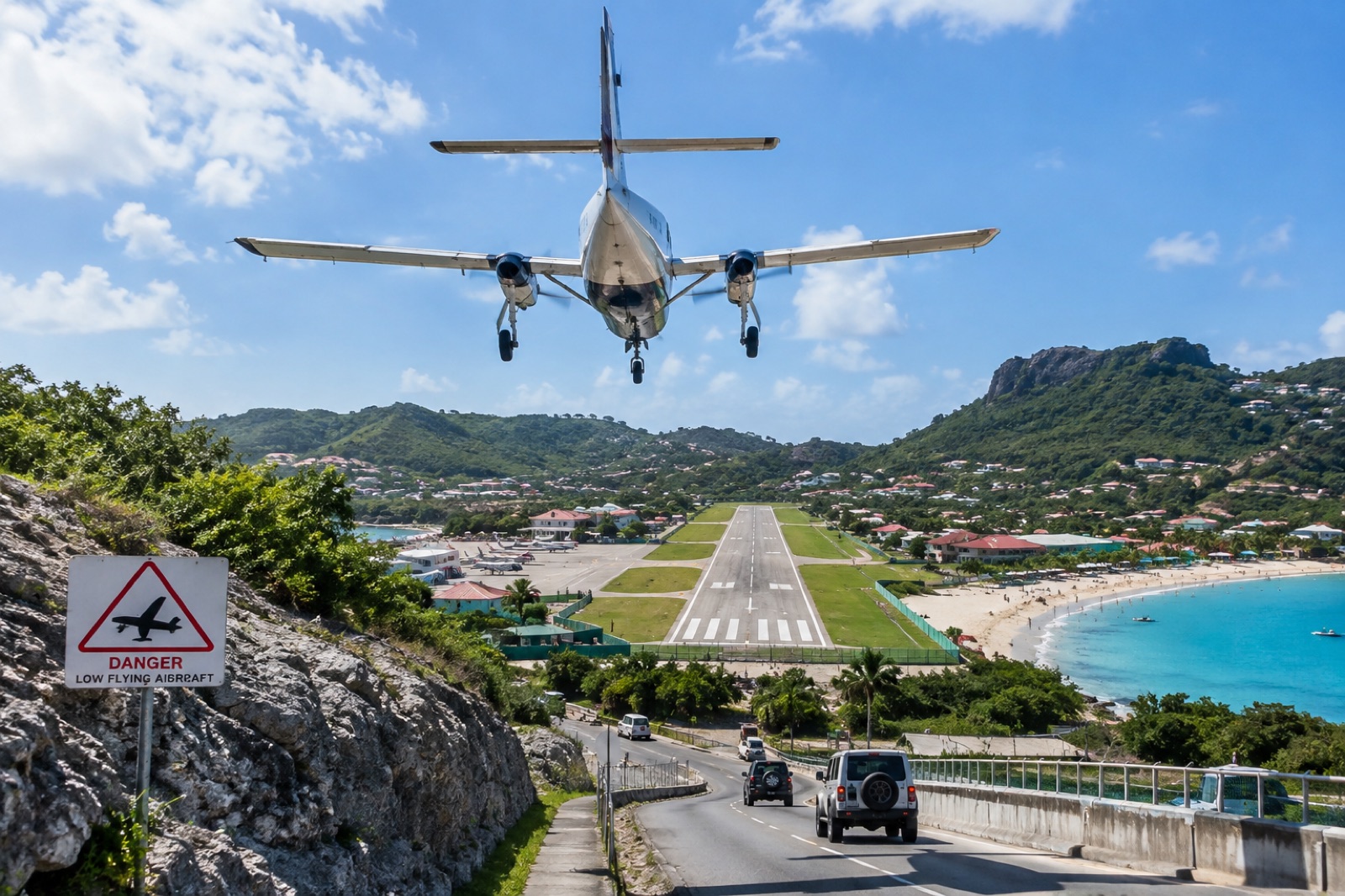
Runway 10/28 is 646 metres of concrete, 18 metres wide, with a 44-foot drop from the western threshold to the eastern one, which sits four feet above the sand. The aerodrome chart describes the approach in two words that pilots take seriously: delicate, for terrain and turbulence. Arrivals on runway 10 come over Sugarloaf at 1,500 feet after a mandatory reporting point, drop over the hill road and the lowered ridge, and land downhill toward the bay. A go-around on the opposite runway is possible only by a right turn, and only before the point abeam Eden Rock. Take-offs on runway 28, toward the hill, are prohibited at all times. So is any movement with more than 25 knots of crosswind on a dry runway, 20 on a wet one. There is no control tower, only a flight information service, no instrument approach, no fuel on the field, and no night landings: the airport opens at 7 a.m. and closes fifteen minutes after sunset, which on December 25 means a last movement around 5:59 p.m. and on December 31 around 6:02 p.m. A principal whose jet lands at St. Maarten at five in the afternoon is not sleeping on St. Barths that night, unless the boat is booked.
The weight limit is 5.7 tonnes, which is why the aircraft you will see are the Twin Otter, the Pilatus PC-12, the Cessna Grand Caravan and the Islander. Helicopters do land, on two dedicated stands, and the larger types, the AW139, H160, H175 and S-76, need the airport’s prior agreement and may only come in when no other helicopter is parked. The crews are qualified for this one field: since April, a pilot’s right to fly there rests on an aptitude recognized by an instructor, earned with three full-stop landings on runway 10, a go-around and a balked landing, and kept alive by flying the field as captain at least once in six months. Commercial operators hold an authorization from the regional aviation authority for each aircraft type, applied for sixty days ahead. None of this is a reason to worry. It is the reason the last hop is flown by a handful of local operators and not by whoever happens to have a turboprop that week.
Where the jet lands
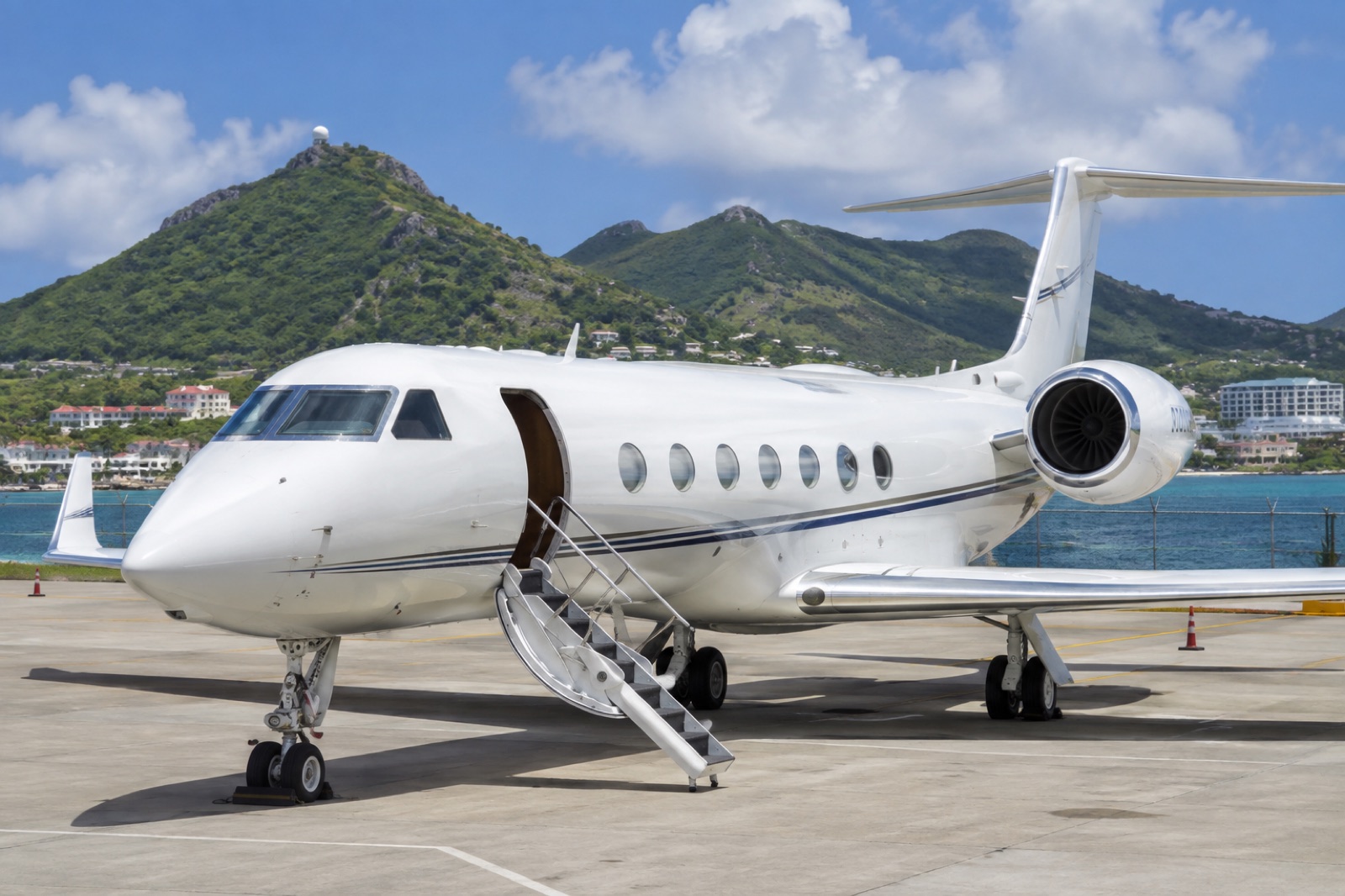
St. Maarten is the natural gateway: 17 nautical miles and a 15-minute flight from Gustaf III, a 7,546-foot runway that takes any business jet, and two FBOs west of the main terminal, ExecuJet by Atlantic Aviation and Signature, where private passengers clear customs and immigration inside the building. Landing clearance and a slot are requested in advance through the handler. The terminal rebuilt after Hurricane Irma reopened in November 2024, and the airport carried about 1.8 million passengers last year, so the busy days are busy. The local commuter that flies the hop in Grand Caravans asks for an hour and a quarter of connection time inbound and recommends two outbound; Winair flies it in Twin Otters; St Barth Executive, the only airline based on St. Barths, flies three PC-12s privately. From Teterboro it is 1,481 nautical miles to St. Maarten, from West Palm Beach 1,075: call it three hours out of South Florida and closer to four from the New York area, in anything from a Challenger 650 up.
San Juan is the other answer, and for a US client it has a quality of its own: it is US soil. Jet Aviation runs an FBO there with customs on site, Tradewind Aviation flies St. Barths from San Juan in about an hour on PC-12s, shared or private, with its 2026-27 bookings open, and the return home from San Juan is a domestic flight, with no customs stop at the Florida end. Antigua is the third option: a 9,967-foot runway, Signature on the field, and Tradewind’s shortest hop into St. Barths, about 35 minutes.
By sea, and by helicopter
When the light is gone or the stands are, the sea works. The Great Bay Express runs Philipsburg to Gustavia in about 45 minutes, sea permitting, with a last departure from Gustavia at 6:45 p.m., and the crossings over Christmas and New Year sell out days ahead; the channel between the two islands can be rough. A private boat transfer does the same run, and a yacht clears customs and immigration online, with pre-clearance available 24 hours before arrival. Last New Year’s Eve Gustavia counted a record 226 superyachts over 24 metres in and around the harbor, 155 of them on charter, which is why the stern-to berths for this coming New Year were spoken for months ago. A helicopter from St. Maarten is the third way in, subject to the airport’s stands and its rules on the larger types.
The papers
St. Barths is French, but no French overseas territory belongs to the Schengen area, so the biometric Entry/Exit System we wrote about last week does not apply here, nor in Guadeloupe or Martinique. A US passport enters visa-free for up to 90 days in any 180, provided it is valid three months beyond the departure date, with two blank pages. Sint Maarten, on the Dutch side, admits US citizens without a visa for up to 90 days, and every traveller files a free electronic entry card before arrival. The hop between the two is an international flight: passport control is done at Gustaf III on arrival, during airport hours, and customs there wants 24 hours’ notice. The commuter operator adds that passengers with carry-on only need not clear immigration at St. Maarten in transit; check that with the handler for the day.
Coming home, there is no US preclearance at St. Maarten, nor at Antigua: in the Caribbean it exists only at Nassau, Bermuda and Aruba. The aircraft clears at its first US landing, the manifest is filed at least an hour before departure, and at West Palm Beach permission to land is requested at least two hours before leaving the island, with inspection hours that end at 7:30 p.m. From San Juan, none of that applies. Hurricane season, for the record, ends on November 30, and this year’s has so far been a quiet one; December on the island runs at 24 to 29 degrees Celsius with a dozen showery days.

What we tell our own clients
- Book the last hop with the jet, not after the villa. This winter the hop needs a coordinated request and there is one spare stand for late requests.
- Land at St. Maarten with daylight to spare: the field closes fifteen minutes after sunset, and in late December that is a few minutes before six.
- Decide the return before the trip. Through San Juan it is a domestic flight home; through St. Maarten it is a customs stop in Florida, with hours.
- If the party will not fit a turboprop in one go, or the light will not hold, the boat is the plan, and it sells out too.
The rest is what Trans World Jets does: the aircraft to the gateway, the operator and the crew for the hop, the handler’s request into COHOR, and the cars on both islands. Write to sales@transworldjets.com or send the dates through our quote form, and start with the night you want to arrive.
Ryan Curtis
Ryan Curtis is the Vice President of Trans World Jets, overseeing charter operations, aircraft sourcing, and client relationships. With over two decades in private aviation brokerage, Ryan focuses on matching clients with the right aircraft for missions ranging from last-minute business travel to multi-leg international tours. He works alongside his brother Evan at Trans World Jets in Jupiter, Florida.
Planning your own charter?
Every mission is different. Reach out for a personalized quote from a broker who handles flights like these every day.