
Every strong quarter brings the same question to a broker's desk: should I just buy one? An honest look at the 2026 numbers, the ownership break-even around 250 hours a year, the tightest used jet market in years, and the tax rule that complicates the answer.

There is a question I hear every time the market has a good run, and I have heard it more this year than in the last five combined: “Evan, at what point should I just buy one?”
It is a fair question, and it deserves a straight answer rather than a brochure. We are a brokerage. We arrange charter, and we also arrange aircraft sales when buying is genuinely the right call, so we have no incentive to talk you out of ownership if the numbers support it. In 2026, for most of the people asking, they do not. Here is the honest math, and the two market facts this year that most buyers only discover after they have started shopping.
The arithmetic has not moved: around 250 hours a year
Full ownership starts to make financial sense at roughly 200 to 250 flight hours per year, and the case strengthens above 300. Below that line, the fixed costs of owning run against you every day the aircraft sits, and chartering the same missions costs meaningfully less over a decade.
That threshold is not a broker’s talking point. It falls out of the cost structure. An owned jet carries its full overhead whether it flies or not: a two pilot crew runs well into the mid six figures a year once salaries, benefits, and recurrent training are counted, and hangar, insurance, management, and scheduled maintenance stack on top. For a large cabin aircraft, the fixed bill alone clears two million dollars a year before the first hour is flown.
Now the uncomfortable part. Most people who ask us the question fly 50 to 150 hours a year. They are busy, successful, and airborne twice a month, and they are still only halfway to the line where a whole aircraft pays. An asset that flies 100 hours a year spends more than 98 percent of its life parked, fully crewed and fully insured.

2026 is a seller’s market for jets and a buyer’s market for access
Suppose the hours do pencil out. The second problem is the shelf, because 2026 is one of the tightest markets for buying a jet in recent memory.
Depending on whose count you use, somewhere between 4 and 7 percent of the world’s business jet fleet is listed for sale, against the 8 to 10 percent that defines a balanced market. The scarcity is worst exactly where demand is strongest: availability of modern large cabin jets under seven years old has fallen roughly 36 percent year over year. The factory route is no faster. Gulfstream and Bombardier are working order books that stretch toward 2029, and Gulfstream’s deliveries will stay largely flat this year as completion and supplier constraints cap output. Order new today and you are planning around a wait measured in years, not quarters.
So the 2026 buyer faces thin inventory, firm pricing, and a long queue. Meanwhile the flying itself has never been more available. Global business jet departures are running at record levels, about 3.95 million on a trailing twelve month basis, up nearly 5 percent year over year, and the same market report notes pre-owned aircraft now taking an average of 98 days to sell. Sit with that contrast for a moment: aircraft are hard to buy and slow to resell, yet lift is everywhere. The charter market is deep, competitive, and improving in quality, because operators have every incentive to keep their fleets flying. Scarce assets, abundant access. That is the whole 2026 story in four words.
The honest counterargument: the tax code wants you to buy
A straight article has to give you the other side, and this year it is a real one. The 2026 tax framework restored 100 percent first year bonus depreciation for business aircraft, which lets a qualifying buyer write off the full purchase price in year one. It is a large part of why the used market emptied.
If you fly 250 hours or more a year, mostly for business, on repeatable missions, that provision can genuinely change the answer, and the right move is a conversation with an aviation focused CPA before any of us. What the depreciation does not change is everything else: the crew you now employ, the hangar you now rent, the one cabin that must fit every mission, and the resale market you will eventually meet from the other side. A tax benefit on the purchase does not convert a 120 hour flyer into a 300 hour owner. When a client’s profile truly supports buying, we say so and we help them do it properly. That happens. It is just rarer than the marketing around ownership suggests.
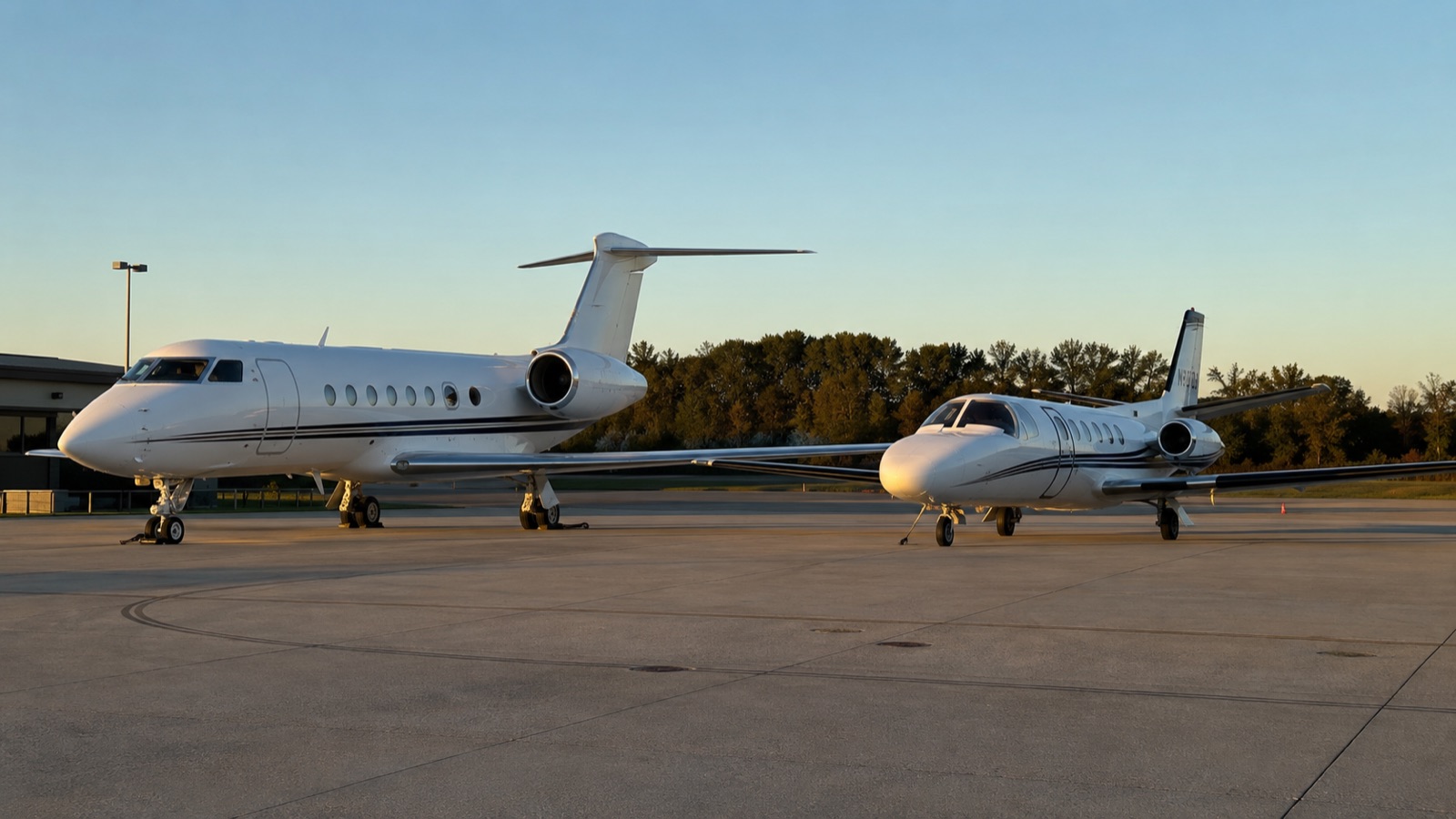
What access looks like when it is engineered
The strongest argument for charter in 2026 is not cost avoidance. It is that access, done properly, is simply a better product than ownership for most flying lives.
An owner has one aircraft, one cabin, one range figure. A charter client has the market. The Tuesday hop from Palm Beach to Teterboro goes on a light jet like the Phenom 300E. The team trip to the coast rides a Challenger 3500 with a flat floor and a full office. The family’s summer crossing to Europe takes a Gulfstream G650 or a Global 7500 with beds made before boarding. Each mission gets the right tool, and you never pay to drag fourteen empty seats on a two person flight.
Access also deletes the failure modes of ownership. When an owned aircraft goes mechanical the day before Thanksgiving, the owner has a problem measured in days. When a chartered aircraft goes mechanical, the recovery is our network, and the replacement tail is usually sourced before the passengers wake up. No crew turnover to manage, no hangar negotiation, no residual value to watch. And flexibility starts to pay instead of cost: repositioning flights across the market open empty leg opportunities that owners, locked to one tail number, can never use.
When buying is the right call, we will say so
There are profiles where ownership wins, and it would be dishonest to end without them. If you fly more than 250 to 300 hours a year on predictable routes, if your schedule cannot tolerate even a rare sourcing delay, or if the aircraft serves a company flight department with genuine business use behind the depreciation, owning can be the better instrument. Even then, most owners we work with keep chartering around the edges, for the oversized group trip, the second simultaneous mission, or the leg their own cabin does not fit.
The point is not that charter always wins. The point is that the answer is arithmetic, not identity, and in 2026 the arithmetic leans harder toward access than it has in years.
Run your last twelve months with us
Here is a standing offer that costs you nothing. Send us your last twelve months of private flying, routes, passenger counts, and hours, or even a rough sketch of them, and we will map it against both columns: what those missions cost to charter properly, and what the same year looks like inside an ownership budget. If the math says buy, we will tell you, and we can run the acquisition. If it says charter, you will know exactly why, in your own numbers rather than an industry average.
Start the conversation through our quote request page or write to sales@transworldjets.com. Trans World Jets has spent fifteen years helping clients fly this way: the right aircraft for each mission, none of the overhead, and a straight answer when the question is worth real money.
Evan Grossman
Evan Grossman is the President of Trans World Jets, a private aviation brokerage based in Jupiter, Florida. With over two decades of experience arranging charter flights for corporate executives, families, and government clients worldwide, Evan specializes in complex logistics, medical evacuations, and VIP airliner charter. He founded Trans World Jets in 2011.
Planning your own charter?
Every mission is different. Reach out for a personalized quote from a broker who handles flights like these every day.