Four Grands Prix in four weeks, three borders, and a different rule at every airport. A broker's guide to Formula 1's autumn in the Americas: the ramp reservations and Sunday slots at Austin, why the jet lands at Toluca and why a Mexico charter permit cannot be rushed, the São Paulo airport closest to Interlagos that you cannot use, Brazil's e-visa, the Saturday-night race in Las Vegas and its new customs building, and the legs in between.

Formula 1 spends the autumn in the Americas. Austin races on Sunday, October 25, Mexico City on November 1, São Paulo on November 8, and after a free weekend, Las Vegas runs on the night of Saturday, November 21. For a principal who follows the paddock, that is four race weekends, three borders and four airports that each run their own rules on race week. For whoever organizes the trip, the order matters less than the lead times, and some of them are already running: Austin is 26 days away, a charter permit for Mexico takes longer than that, and Brazil now wants a visa.
Austin: a reservation to land, and one to leave
The FAA has published its 2026 notice for the United States Grand Prix. From Thursday, October 22, to the end of Sunday, October 25, every arrival and departure at Austin-Bergstrom, drop-and-goes included, needs a ramp reservation made through one of the three FBOs, Signature, Atlantic or Million Air. A flight without that number is not accepted, and a diversion into Austin is not accepted either. The notice warns that parking may be unavailable at every airport within 50 nautical miles, so Austin Executive and San Marcos are an alternative only if their own FBOs say so. Customs is available at Austin-Bergstrom alone, which matters for a client arriving from abroad.
The second reservation is for the way out. On race Sunday, every non-scheduled departure between 4 p.m. and midnight needs a slot, 28 to 40 an hour, confirmed 24 hours ahead or deleted. The race starts at 3 p.m., so the principal who wants to be wheels-up after the podium is competing with everyone else who had the same idea. The airport also has taxiway works and no CAT III approaches on three runways during race week. From the FBO the circuit is 15 to 20 minutes by road on a normal day and much longer on race day; one helicopter company holds exclusive rights to the circuit’s helipads, 10 to 15 minutes from the Austin-Bergstrom ramps.
Mexico City: Toluca, altitude, and a permit you cannot rush
The Autódromo Hermanos Rodríguez sits about four kilometers from Mexico City’s main airport, and private jets cannot use it: Benito Juárez has long been closed to general aviation, except official government flights. The business aviation gateway is Toluca, a 24-hour airport of entry at 8,460 feet, with customs and immigration around the clock; last year they were done at a dedicated ramp rather than planeside. Trade guides for race week allow up to two hours by road into the city and warn that overnight hangar space is scarce.
The altitude is not a detail. Every published range for a business jet assumes standard conditions at sea level, and Toluca is not that. The leg from Toluca to São Paulo is about 4,000 nautical miles, and whether it is flown nonstop with the full party and their luggage is a performance calculation the operator makes on the day, not a figure from a brochure.
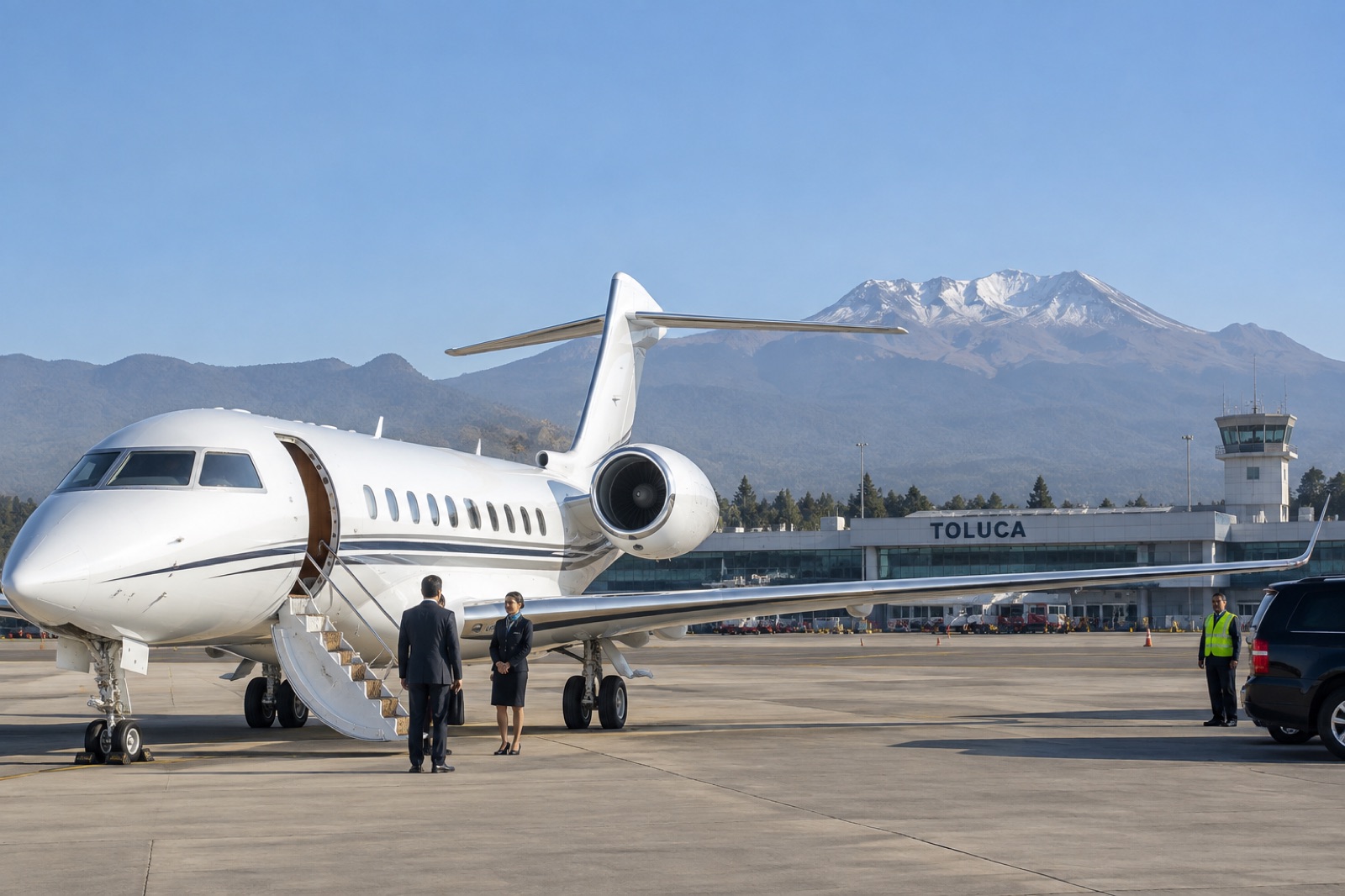
Then the paperwork, which keeps changing. Under the current rules, a charter operator flying into Mexico needs an indefinite blanket permit from the Mexican aviation authority, and a new one takes up to 90 business days, often longer; single-trip charter permits no longer exist, and each flight still needs a landing authorization at least ten business days ahead. Since May 13 of this year, every flight in Mexico also needs a prior approval from the authority’s headquarters, with delays of more than two hours reported. The practical consequence is simple: for the Mexico City race, the question is not which aircraft is free, but which operator already holds the permit. An operator that does not hold it today will not have it by November 1. US passengers need only a passport, no visa, for stays of up to 180 days.
São Paulo: the airport nearest the track is the one you cannot use
Congonhas is ten kilometers from Interlagos, and for a private jet from abroad it is out of reach. It is not an airport of entry, slots are required at all hours, general aviation is capped at four movements an hour until works planned to end in 2028, and there is no ramp parking for non-commercial flights. The jet clears into Brazil at Guarulhos, open around the clock with a private terminal and customs, about an hour by road to the circuit; at Catarina, an airport built for business aviation with an 8,104-foot runway and international status since 2021, about an hour and a quarter away; or at Viracopos, further out.
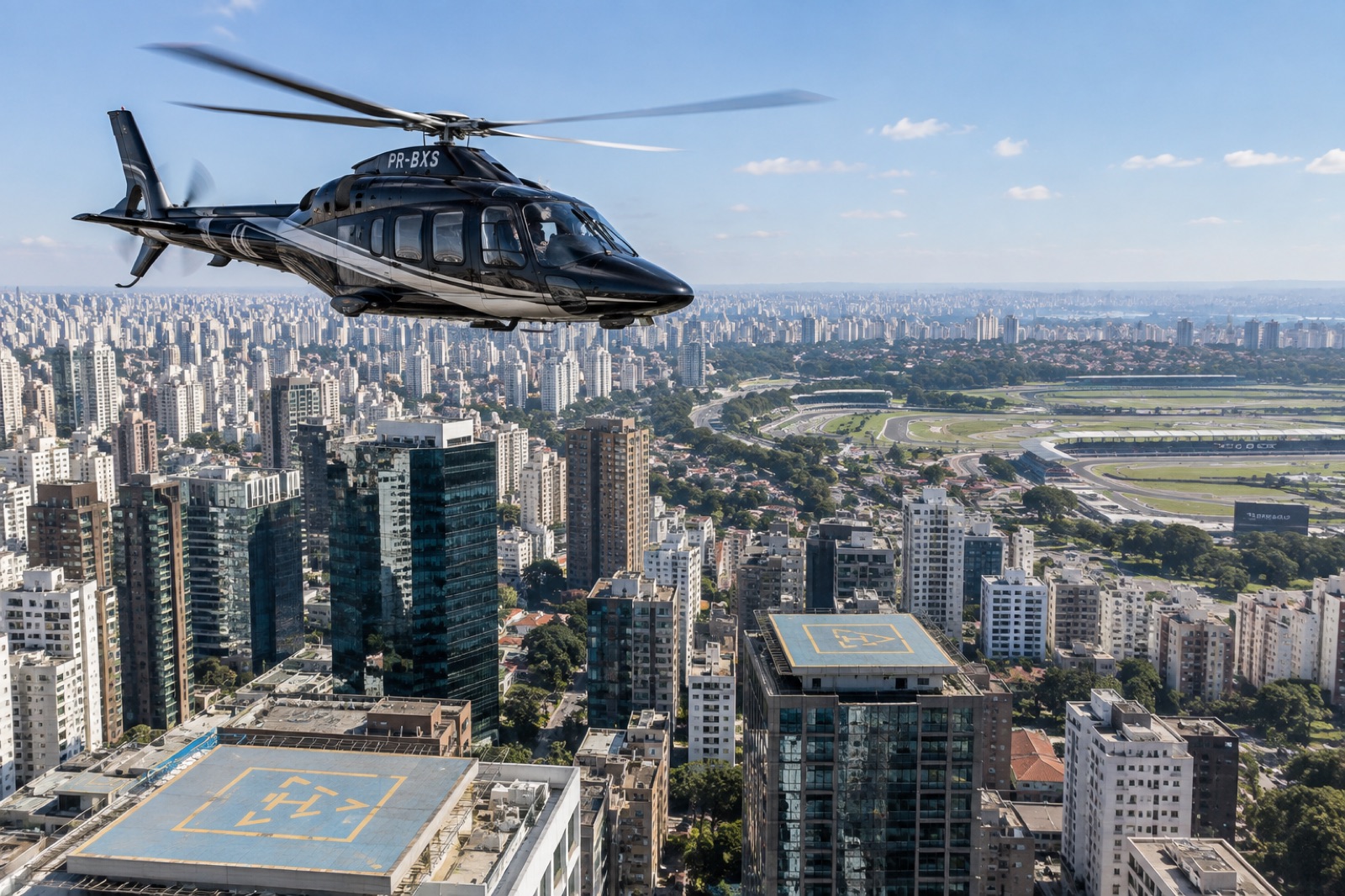
São Paulo solves the last mile its own way: it has one of the largest city helicopter fleets in the world, and in recent years helicopters have shuttled race-weekend guests from Guarulhos and from the business district to a helipad at Interlagos in about ten minutes. We arrange that transfer alongside the jet.
Two formalities belong on the calendar now. Brazil has required an e-visa of US, Canadian and Australian citizens since April 10, 2025; it is applied for online, allows stays of up to 90 days, and is valid ten years for US passport holders. A principal who last went to Brazil before 2025 almost certainly does not have one. The aircraft needs its own clearance too: a US charter operator holds a permit from Brazil’s aviation authority, valid 60 days, and the flight is notified at least 48 hours before landing. Plan on one landing in Brazil: a further leg inside the country needs a separate authorization that can take two business days, and for a charter it may be refused outright as cabotage.
Las Vegas: a Saturday-night race and the Sunday-morning wave
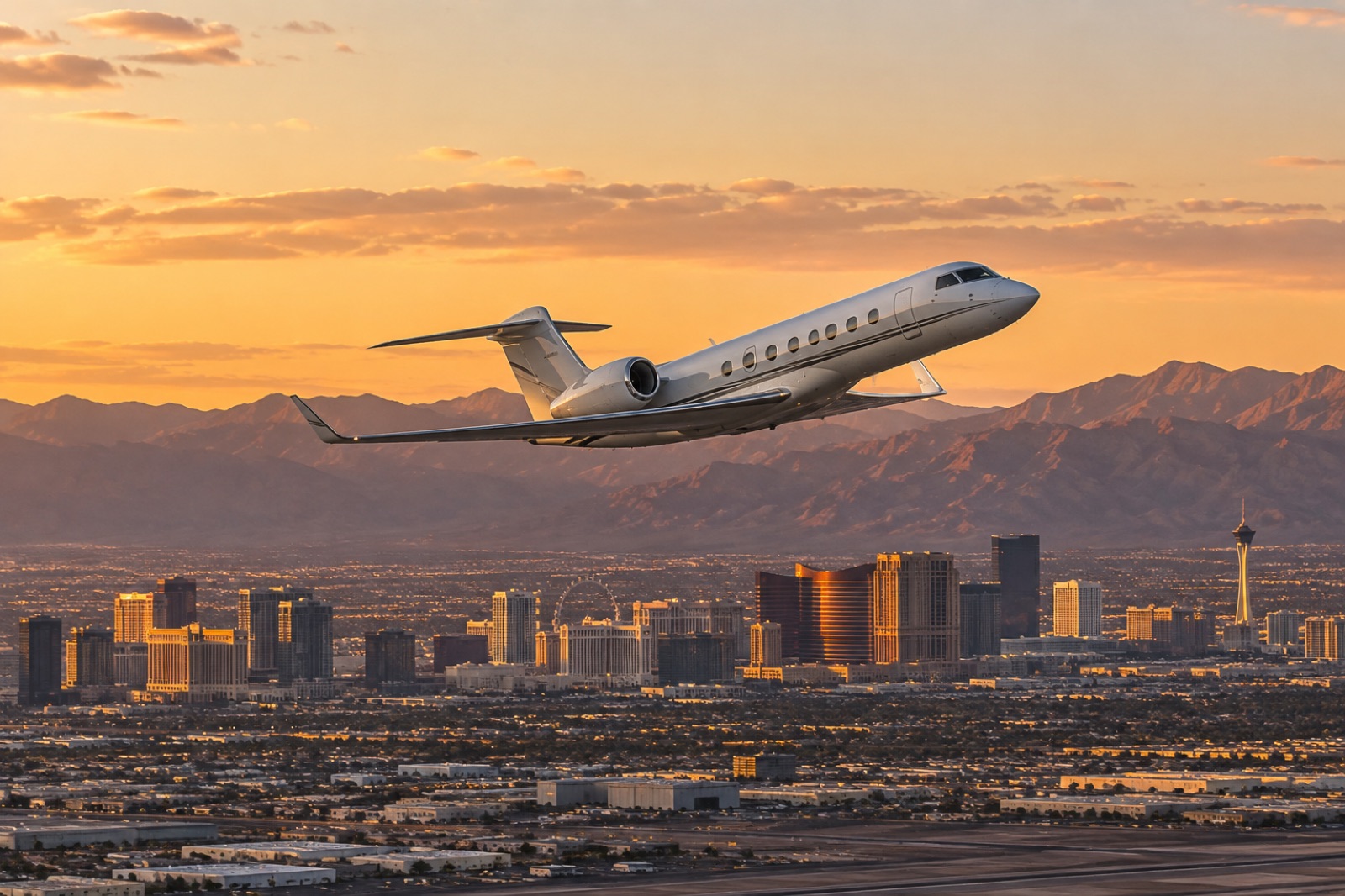
For most US clients Las Vegas is a domestic trip, and the pressure is on parking. Qualifying is on Friday night and the race starts at 8 p.m. on Saturday, November 21, on the Strip. In 2023 more than a thousand private aircraft came to town, and Henderson Executive, North Las Vegas, Boulder City and Mesquite were full for overnight parking by November 14. In 2024 the FBOs at Harry Reid were fully booked, with more than 800 parking reservations across the valley. Last year the FAA ran parking reservations at four airports, drop-and-goes included, and a departure slot program for the whole of Sunday; bookings were lower than in 2024, but the rules stayed. The FAA has not yet published its 2026 notice; each of the last three years had one.

Two things are new or worth knowing. On September 17, a new customs facility for private aircraft opened on the west side of Harry Reid, built with Signature, so international arrivals now clear in a dedicated building; inspections run from 8 a.m. to 8 p.m., and permission to land is requested at least twelve hours ahead. And last year the circuit closed the streets around it from 1 p.m. on each race day until about 2 a.m., so the drive from the FBO to the hotel is planned around the closures, not around the map.
The legs between the races
Austin, Mexico City and São Paulo are three consecutive weekends, and a party that flies all three crosses from the United States into Mexico, from Mexico to Brazil, and then home. Two rules shape that last leg. First, a private or charter aircraft arriving from Brazil or Mexico must land at the designated US airport nearest the point where it crosses the border, unless it holds a Border Overflight Exemption, which is requested at least 15 days before the flight. A nonstop from São Paulo to Las Vegas, or to anywhere inland, is therefore planned weeks ahead or it does not happen. Second, that nonstop is about 5,280 nautical miles, more than ten hours in the air. On paper the Global 7500, Global 8000 and Gulfstream G700 all have the range, but under Part 135 a two-pilot crew may fly ten hours in any 24, so the flight is planned with a third pilot, as we explained for the Atlantic crossing. The manifest for every leg into or out of the United States is filed at least an hour before departure.
The free weekend after São Paulo is the natural break. Flying home from Brazil and coming back out for Las Vegas turns the fourth race into a domestic trip with a parking problem rather than the last leg of a tour.
What we tell our own clients
- Austin: the ramp reservation and the Sunday departure slot are made at the same time as the flight, not the week before.
- Mexico City: choose the operator by its Mexican permit before choosing the aircraft, and land at Toluca with time for the road.
- São Paulo: check every passport for the Brazilian e-visa now, and book the helicopter with the jet.
- Las Vegas: secure parking as soon as the FBOs open reservations, and decide in advance whether the aircraft stays or repositions.
- Anyone flying home from Brazil to an inland city: the operator files the overflight exemption at least 15 days ahead, so the itinerary is fixed before then.
The rest is what Trans World Jets does, and what an executive assistant should not have to chase: the operator with the right permits, the crew for the long legs, the handlers and the cars at every stop. Write to sales@transworldjets.com or send the itinerary through our quote form, and start with the races you want to see.
Evan Grossman
Evan Grossman is the President of Trans World Jets, a private aviation brokerage based in Jupiter, Florida. With over two decades of experience arranging charter flights for corporate executives, families, and government clients worldwide, Evan specializes in complex logistics, medical evacuations, and VIP airliner charter. He founded Trans World Jets in 2011.
Planning your own charter?
Every mission is different. Reach out for a personalized quote from a broker who handles flights like these every day.