
The US Open tennis finals land on the most congested weekend of New York's aviation year. A broker's operational guide: the LaGuardia reservation rule that pauses on Saturday, the Sunday the men's final shares with NFL opening night, and where a large group actually lands.

LaGuardia has a departure procedure that exists because of a tennis tournament. The Tennis Climb was created in 1993 to keep departing aircraft from flying over Flushing Meadows during the US Open. It was originally used only two weeks a year, and in 2012 the FAA made it permanent. The agreement behind it could expose the city to penalties of up to $325,000 for excessive flyovers during matches. It is the only Grand Slam that has rewritten the departure procedures of a major international airport. That is the gravitational pull of what sits two miles from LaGuardia every September.
The 2026 US Open is the longest edition in the tournament’s history, twenty-two days of tennis at the Billie Jean King National Tennis Center, played this year around an $800 million rebuild of Arthur Ashe Stadium that continues without interrupting a single match. The singles main draw opens Sunday 30 August and the finals land on 12 and 13 September. This piece is about those last two days, because from where we sit as a charter broker, the women’s final and the men’s final are not the same trip. They are two different New Yorks, twenty-four hours apart.
The closing week is a calendar collision
Start with what else is happening. New York Fashion Week runs 10 to 15 September, roughly seventy shows, and Atlantic Aviation’s Teterboro FBO has already published a ramp congestion advisory covering 9 through 14 September, asking customers to confirm aircraft parking before arrival. Rosh Hashanah begins the evening of Friday 11 September, which loads that Friday afternoon with its own departure wave. Labor Day sits earlier in the tournament, on the round-of-16 days. And underneath all of it, the New York TRACON, the radar facility that sequences every aircraft in the metro area, is staffed at 129 certified controllers against a target of 226. The system that absorbs all this demand is running at 57 percent, a shortfall severe enough that in June the FAA offered scheduled carriers relief on up to ten percent of their slots at JFK and LaGuardia just to keep the airspace manageable. That is the baseline the finals traffic has to fit into.
We saw what event compression does to this exact airspace in July, when the World Cup final was played at MetLife Stadium and arrivals into Teterboro ran 104 percent above the prior year. We wrote about that tournament’s operational traps in our World Cup host-city guide, and the finals weekend of the US Open is the same physics on a tighter map: one tennis center, three primary business airports, and four other demand events stacked on the same six days.
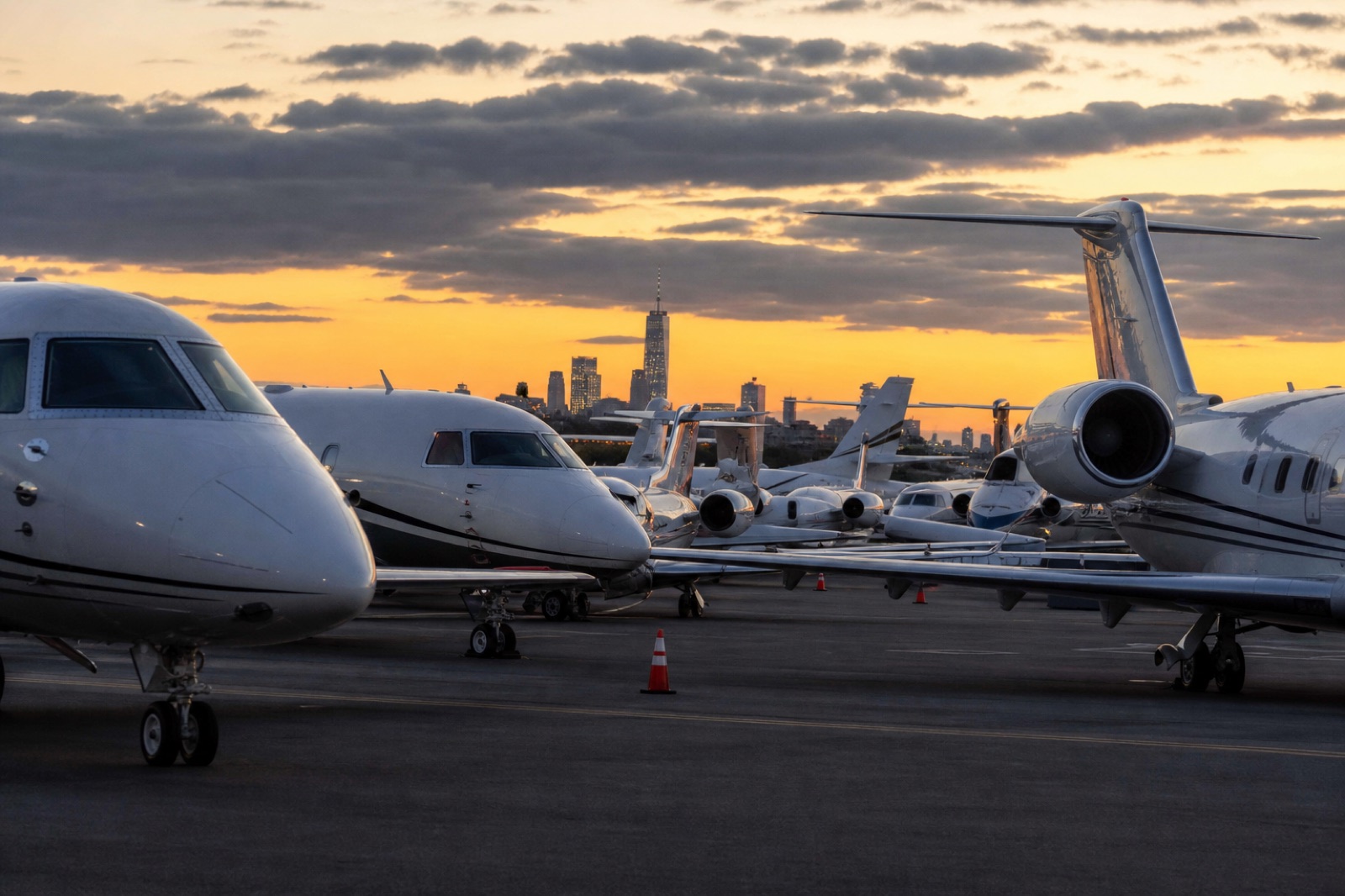
Saturday 12 September: the quieter final
The women’s singles final is Saturday at 4 p.m. Here is the detail almost nobody outside operations knows: LaGuardia, the closest airport to the stadium, requires a reservation for every non-scheduled IFR arrival and departure, Monday through Friday from 6 a.m. to 9:59 p.m. and Sunday from noon to 9:59 p.m. Saturday is the exception. The FAA’s own reservation system states it plainly: Saturday reservations are not required at LGA.
So the women’s final falls on the one day of the week when the two-mile airport operates without a reservation requirement, before Fashion Week peaks, and before the NFL enters the picture. If your US Open is the Saturday final, the logistics are the friendliest they will be all weekend, and the airport conversation can genuinely include LaGuardia rather than defaulting away from it.
Sunday 13 September: two stadiums, one ramp
Sunday is a different animal. The men’s final starts at 2 p.m. in Flushing Meadows, which puts the private departure wave at roughly 4 to 7 p.m. That same evening, eight miles from Teterboro, the Giants open their season against the Cowboys at MetLife Stadium, Sunday Night Football, 8:20 kickoff, with its arrival wave landing in exactly the same window. Atlantic Aviation begins applying NFL special event fees at Teterboro on that precise date. And LaGuardia is back under its reservation regime from noon, with slots released only 72 hours ahead.
Two stadium crowds moving in opposite directions through the same ramps, in the middle of Fashion Week, on a Sunday. None of this makes the trip impossible. All of it makes the trip something you decide early and hand to someone whose job is sequencing it, which is the same conclusion we reached about single-venue event weekends, multiplied by a second stadium.

Where you actually land, and where a large group cannot
The default New York answer is Teterboro, and for most parties it remains the right one, with two caveats that have teeth. First, a reservation number is now required for every arrival into Teterboro, assigned through the FBO, and aircraft needing customs must secure it in advance. Second, Teterboro enforces a hard 100,000-pound weight limit, in force since 1977. A VIP airliner carrying a corporate hospitality group does not squeeze under that cap. It does not go to Teterboro at all.
That group lands at JFK, where the general aviation terminal runs 24/7 and the runways stretch past 14,000 feet, or at Westchester, which takes aircraft over 120,000 pounds only with prior permission, or at Republic on Long Island, where customs clears by appointment with four hours’ notice. Each field carries its own curfew arithmetic: Teterboro asks for no non-essential movements between 11 p.m. and 6 a.m., Westchester’s voluntary restraint runs from midnight to 6:30 a.m., and Republic’s from 10 p.m. to 7 a.m. As for drive times, the industry quotes Teterboro to Flushing Meadows at anywhere from 35 to 60 minutes, and the spread itself is the honest answer: Queens on a finals afternoon is not Queens on a Tuesday morning. For principals who want the last mile solved rather than survived, a helicopter lift from Manhattan to LaGuardia, met planeside by a waiting SUV, puts you at the tournament’s VIP entrance in roughly twenty-five minutes door to door, and we arrange the rotor and ground legs alongside the fixed-wing itinerary as one sequence. And one honest note a broker should volunteer: on a finals afternoon, the Long Island Rail Road from Moynihan Train Hall reaches the grounds in about twenty minutes, and for part of a group that can beat any car we could send.

What we tell our own clients
The market has trained itself to book late. One large operator reported this summer that a quarter of its flights were booked within four days of departure, and most of the year that works. The finals weekend of the US Open is the kind of date that punishes it, because the constraint is not aircraft availability in the abstract, it is parking, reservations, and sequencing on six specific days in the most supervised airspace in the country.
So the order of decisions matters: the day you are attending, the size of your party, the aircraft that party actually needs, and only then the airport that aircraft can use on that day, with its reservation secured the moment the window opens. Run it in that order, and the tournament that rewrote LaGuardia’s departure routes becomes a straightforward day out. Run it backwards and you are negotiating for ramp space during Fashion Week.
If the US Open is on your September calendar, for the finals or any session of the closing week, reach Trans World Jets at sales@transworldjets.com or request a quote. We will tell you honestly what your dates allow, and we will have an opinion about Saturday versus Sunday.
Ryan Curtis
Ryan Curtis is the Vice President of Trans World Jets, overseeing charter operations, aircraft sourcing, and client relationships. With over two decades in private aviation brokerage, Ryan focuses on matching clients with the right aircraft for missions ranging from last-minute business travel to multi-leg international tours. He works alongside his brother Evan at Trans World Jets in Jupiter, Florida.
Planning your own charter?
Every mission is different. Reach out for a personalized quote from a broker who handles flights like these every day.